
Accelerating Carbon Trading in Garut, IPB’s Partner Village Visited by the Ministry of Forestry and UNDP
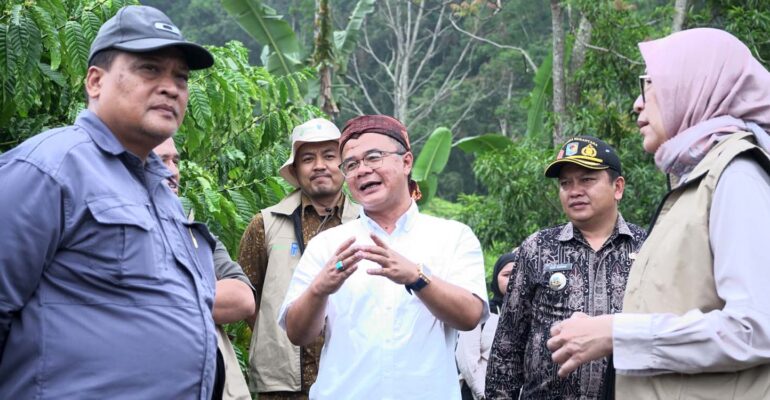
In an effort to accelerate the initiation of carbon trading in the social forestry (PS) sector, the Directorate of Social Forestry Area Preparation (PKPS) together with the United Nations Development Programme (UNDP) visited a partner village mentored by IPB University in the Integrated Area Development (IAD) zone in Jayamekar Village, Pakenjeng Subdistrict, Garut Regency, West Java.
This collaborative step marks a significant milestone in integrating environmental sustainability with the economic empowerment of rural communities through an inclusive carbon trading scheme.
The Director General of Social Forestry (Dirjen PS) at the Ministry of Forestry, Catur Endah Prasetiani P, SSi, MT, commended the progress of social forestry in Jayamekar Village, which has been underway since 2023.
“Since we have support from IPB University here, we need to utilize it to improve the quality of life. Our ultimate goal is clear, to ensure the community prospers, the forest remains sustainable, and environmental sustainability is continuously maintained,” she added.
In terms of assistance, IPB University emphasizes a data driven approach as the foundation for strengthening the village economy. The Head of the Institute for Agromaritime Development and Innopreneurship Acceleration (LPA2I) at IPB University, Dr Handian Purwawangsa, explained that measurements based on farmer activities are key.
“The approach to fostering community economic growth involves measuring the number of trees planted by farmers. Through this model, social forestry is seen as a highly promising future for improving farmers’ well being and standard of living,” he explained.
This approach positions the community as the primary actor, while ensuring that the economic benefits of carbon trading are felt directly at the village level.
Similarly, the Regent of Garut, represented by Dedy Mulyadi as Assistant for Economy and Development at the Garut Regency Secretariat, welcomed this program. He believes this program is of high urgency for optimizing the natural potential in Garut Regency.
These steps to strengthen the local economy align with the commitment of PT Astra International. Bondan Susilo, Head of the Environment Department at PT Astra International noted that Garut has successfully become the best representative region or model for the success of Astra’s Productive Carbon Forest-Prosperous Village program.
International support has also been strong. UNDP representative Afifah Arifin stated, “We strongly support this program. We have seen firsthand how the empowerment process here has actively involved women.
“Our commitment at UNDP is to ensure carbon trading operates with the highest integrity, and most importantly, that local communities are fully involved in the entire decision making process,” she said.
The event continued with a tree planting activity and a tour of the demonstration plots (demplots) managed by local community groups. To conclude, the delegation was taken on a tour of the downstream processing success at the coffee production facility. This coffee processing ecosystem serves as a tangible representation of the implementation of upstream-downstream integration in social forestry commodities.
The existence of this facility demonstrates that the community is not only capable of producing raw materials but has also successfully managed the value added products, which are expected to lead to the strengthening of a sustainable local economy in Pakenjeng Subdistrict. (*/Rz) (IAAS/EPK)

