Horticultural Trade Balance was Deficit
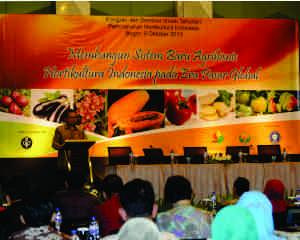
Dr. Ir. Nunung Nuryartono, Head of the Center for International Study for Economics and Applied Finance (Intercafe), the Institute for Research and Community Service, Bogor Agricultural University (LPPM-IPB) explained the interesting facts about the future development of horticultural products in the global era. It was predicted that Thailand and China became the countries’ largest exporters of onion and garlic. The question was, when AEC 2015 was enacted, how was the readiness of Indonesia to beat Thailand, even Vietnam.
In 2011, the Gross Domestic Product (GDP) of Indonesia was high enough, so that Indonesia truly became an attractive market for foreign exporters. The question was, whether the Indonesian businessmen would be the local, regional or international players? The fact showed that the national horticultural production as if stagnant in the period of last five years. Whereas with the increase in income per capita, the trend was quite good, there was allegation of domestic demands for horticultural products increased.
“While according to the data, the national horticultural trade balance is really depressed, the transaction is deficit. Indeed the impact is effective when the government implements the policy of import quota, the import falls drastically. But, this is the short-term solution, because our product will be treated equally in the people’s countries,“ said Dr.Nunung when becoming the resource person in the Congress and Annual Scietific Seminar of Indonesian Horticultural Association at IPB International Convention Center, Wednesday (9/10). The trade balance for vegetables was the same, it was deficit. The gap was large enough. The government conducted the same policy. “That policy will not be effective for long-term,” he said. Other speakers presented were Ir. Purwito from PT. Great Giant Pineapple and Head of Central Research and Development of Horticulturea, Ministry of Agriculture, Dr. Ir. M. Prama Yufdy, M.Sc.
Talking about the trade context in ASEAN region, Vietnam was able to outperform Indonesia in the last 10 years on the food export. If you were not careful and vigilant, Vietnam would beat Indonesia. For the context of competitiveness, Indonesia in 2011-2012 decreased from the position of 46 to the position of 50. This position was under Thailand (38) and Malaysia (25).
Meanwhile, based on the logistic performance index ranking survey, Indonesia was on the position of 59. Only able to beat Myanmar, Laos and Cambodia. Singapore was on the peak posistion as the entrance of imported product because the logistic performance was good. What was interesting, according to him, the vegetable import was dominated by garlic and onion. While for the imported fruit the most were orange, apple and papaya. And for the largest import medicinal plant was ginger. And the entrance of horticultural import was the most from Singapore. Whereas Singapore was a non-state producer, but it was an entrance into Indonesia.
“Moreover, there is an interesting phenomenon with the infrastructure index of Indonesia after and before autonomy. After autonomy, the infrastructure conditions in several areas experience the decrease. For the research results if it is not offset by other factors (logistics and infrastructure), it will be in vain. In fact so many researches have already been generated, only then how it is supported by existing policies. We shall be able together to push the government to seek the long-term solution so that our horticulture can compete in the international level,” he explained.(zul)