LPA2I IPB University Strengthens Synergy for Agroforestry Development and Conservation in Bulungan Regency
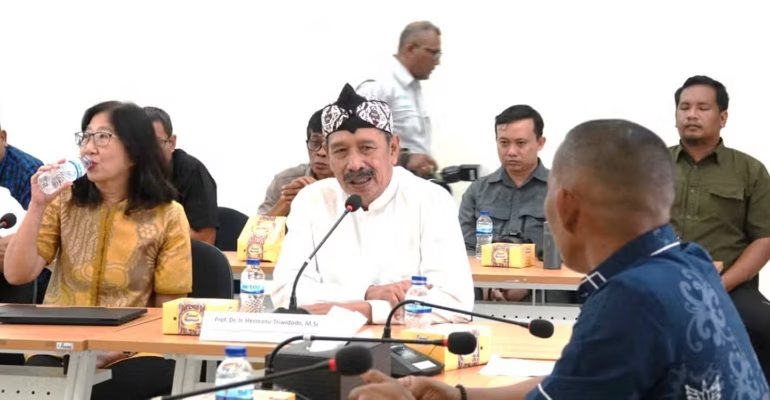
IPB University is partnering with the Bulungan Regency Government and the Nusantara Nature Conservation Foundation (YKAN) to promote agroforestry and conservation in the Kayan Landscape, Bulungan Regency. This collaboration is being advanced through the evaluation of the Collaborative Innovation Center (CIC) program and the Bulungan Regency Tropical Forest Conservation Act (TFCA) program plan.
Agrocomplex School
During a meeting held in the Ballroom of the Startup Center Building at IPB University’s Science and Technology Park (STP), CIC Program Chair Prof Hermanu Triwidodo stated that multi-stakeholder collaboration is key to driving regional development.
“The spirit of “Bulungan BISA” (Sovereign, Inclusive, Synergistic, Adaptive) serves as the foundation for joint program development between IPB University, the local government, and YKAN, one of which is through the CIC Agrocomplex School,” he said.
This meeting served as a forum to align community assistance programs, agricultural development, and forest conservation efforts. Dr Handian Purwawangsa, Chairman of the Institute for Agromaritime Development and Innopreneurship Acceleration (LPA2I) at IPB University, also advocated for the integration of programs implemented through community assistance to provide broader benefits.
“The Mobile Plant Clinic, Real Work Lecture (KKN), and the Dosen Pulang Kampung program can be synergized within a single region to make community assistance more integrated. However, their implementation must also take into account various on-the-ground challenges, ranging from climate change, critical land management, infrastructure limitations, to the sustainability of the assistance,” explained Dr Handian.
From Cocoa to Upland Rice
Through a consortium with the Kawungpitu Institute, LPA2I at IPB University is also developing the TFCA Kalimantan grant program. This program not only promotes cultivation activities but also focuses on the processing and marketing of agricultural products to add value to local commodities.
On that occasion, the Regent of Bulungan, Syarwani, SPd, MSi, stated that in line with the vision of green development in the Regional Medium Term Development Plan (RPJMD) 2025–2029, the development of the agro-complex area in the western corridor is focused on the potential of cocoa, coffee, and upland rice, while taking into account the characteristics and local wisdom of the community.
The development of this area must also support the regeneration of the farming community, the integration of agriculture and livestock, and the “one village, one product” concept. In this way, each village can develop its unique potential while strengthening the local economy.
Targeting Ten Villages
The TFCA program is planned to target ten villages in the Peso and Peso Hilir subdistricts over a 15 month period, from November 2026 to February 2028. Its implementation covers four key areas: institutional strengthening through a Learning Hub, agroforestry intensification, strengthening of area governance, and knowledge management and dissemination.
Through this collaboration, IPB University, together with local governments and conservation partners, aims to develop the potential of local resources into drivers of the community’s economy. The development of agroforestry is expected not only to increase agricultural productivity but also to preserve the ecological functions of the forest so that its benefits can be enjoyed sustainably. (*/Rz) (IAAS/SSR)