Be Aware of Child Abduction Schemes at Schools; IPB University Expert Stresses the Importance of Supervision at School Gates
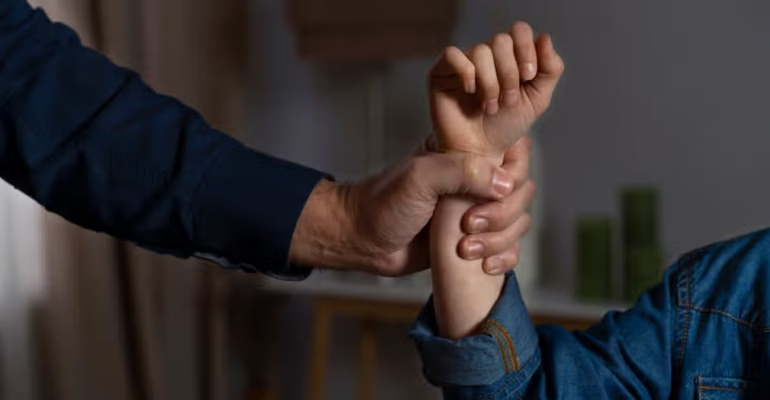
Alleged child abduction schemes near school gates have resurfaced. According to posts circulating on social media, perpetrators try to peek at a child’s name in a notebook or backpack so they can pretend to recognize the child when picking them up.
In situations like this, vigilance regarding children’s safety must be heightened. However, at the same time, the public is also urged not to immediately share unverified information.
Dr Yulina Eva Riany, Chairperson of the Center for Gender and Child Studies (PKGA) at IPB University, stated that school gates are a critical point in child protection because they serve as a meeting place for children, parents, pick up providers, and others especially during dismissal time.
Layered Supervision at School
Parents and schools need to establish a layered supervision system. This can be done by tightening pickup procedures, ensuring that any changes to pickup arrangements are confirmed, and designating a safe area for children who have not yet been picked up.
If there is a suspicious approach, school officials need to document and investigate the incident, contact the parents, and report it to the authorities if there is a threat.
Teaching Body Safety from an Early Age
In addition to tightening supervision, parents need to teach children a specific understanding of safe boundaries or “body safety” and privacy from an early age. Just because someone knows a child’s name doesn’t necessarily mean they’re allowed to pick them up or take them away.
Children need to know what personal information to keep private, such as their full name, address, parents’ names, phone number, grade, and their schedule and route home from school.
“This education can be provided through simulations or role-playing so that children become accustomed to handling situations where a stranger asks for personal information,” she explained.
Dr Yulina also cautioned against educating children in a way that instills fear of all strangers. Children need to be taught to recognize unsafe behaviors and situations, not merely to judge someone based on their appearance.
“Children should feel free to refuse invitations, gifts, or requests to go somewhere with someone without permission from a parent or teacher even if that person seems friendly or claims to know the family,” said Dr Yulina.
Self Protection Skills
She continued, noting that other important skills include the ability to say “no,” create distance, seek help, and report incidents to a trusted adult. Children also need to know safe places and people to turn to for help, such as teachers, security guards, or school staff.
“Children don’t need to figure out beforehand whether someone has bad intentions. If there’s an invitation to go somewhere, a change in pickup plans, a request to keep something secret from their parents, or any action that makes them feel uncomfortable, children should immediately return to a teacher or school staff member,” she explained.
Create a Safe Space for Sharing
On the other hand, parents also need to create a safe space so that children are not afraid to speak up when they experience situations that make them feel uncomfortable. Through consistent education, open communication, and joint supervision between families and schools, children can develop the skills to recognize risky situations and take steps to protect themselves. (Lp) (IAAS/SSR)