
IPB University PKM Pedal Juara Team Encourages Adisa School Students in Bantar Gebang to Continue Their Education
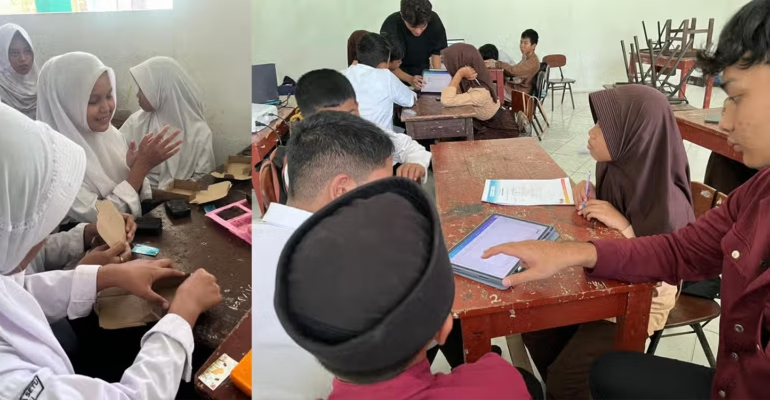
Growing up amid economic limitations and a vulnerable waste processing environment has made it challenging for some children to build self-confidence and determination to pursue their future. On the other hand, conventional education in classrooms is considered not yet fully capable of addressing the realities of life they face.
This condition prompted IPB University students from the Student Creativity Program (PKM) Pedal Juara team to respond to the high risk of dropping out of school and the learning motivation crisis among children in marginalized areas, particularly students at Adisa School, Bantargebang, Bekasi.
Problems Behind the Largest Landfill
Azalea Serafina Princessa, as the team leader, said Bantargebang was selected as the program’s location because the area is home to the largest final disposal site (TPA) in Indonesia, presenting environmental and social challenges, including for children.
“Through observations at Adisa School, we directly saw various problems faced by the students. These findings became the basis for us to design an educational intervention that not only focuses on academic aspects, but also on character building, strengthening resilience, and applicable skills,” said Azalea.
The Pedal Juara team consists of Azalea (team leader), Muhammad Fazza Ilham Ersafero, Resky Amalia Putri, Muhammad Wafi Robbani, and Muhammad Syaamil, together with supervising lecturer Dr Melly Latifah from the Department of Family and Consumer Sciences, IPB University.
From Waste to Products
The Pedal Juara team designed a structured intervention by combining a personal approach based on the Character Strengths theory and experiential learning methods or learning through direct experience.
“Each child is guided to recognize their unique potential while building a never-give-up character. The program also equips students with environmentally friendly entrepreneurship skills by processing waste around them into products with market value,” Azalea explained.
She continued that these skills were then strengthened through bazaar simulations, so that the children not only learned how to make products, but also gained experience in communicating, offering products, and negotiating.
Overcoming Insecurity
According to Azalea and the team, one of the biggest challenges in implementing the program was building self-confidence while overcoming self-doubt among the children. In the early stages, some students tended to be passive, shy, and hesitant even to express their opinions.
This challenge was addressed through an intensive and supportive personal approach, carried out individually with a warm and consistent approach to explore each child’s potential and build their courage. As a result, children who previously tended to withdraw began to dare to appear in front of others, actively express their opinions, and independently practice communication and negotiation techniques when offering products they had created.
Increasing Motivation and Positive Attitudes
Azalea said that before the program was implemented, none of the students had an adequate understanding of opportunities for further education. However, after the program intervention, all participants moved into the high knowledge category.
A similar increase occurred in the aspect of motivation. From initially only 20 percent of students, all participants now have a strong drive to pursue higher education.
Not merely providing moral encouragement, all participants were also equipped with the ability to develop a detailed roadmap for their future studies, starting from determining their aspirations, concrete steps to achieve them, and their target schools after graduating from junior high school.
“For the surrounding environment, this program also changed the way people view waste. They no longer see it merely as an environmental problem, but also as an economic opportunity and a learning medium for children, while opening opportunities for multi-stakeholder collaboration to sustain education at Adisa School,” said Azalea. (IAAS/HRD)

