Helbygoom, Functional Snack Made from Tuna Fish Eye Oil by IPB Innovator, Showcased at Food Ingredients Asia 2026
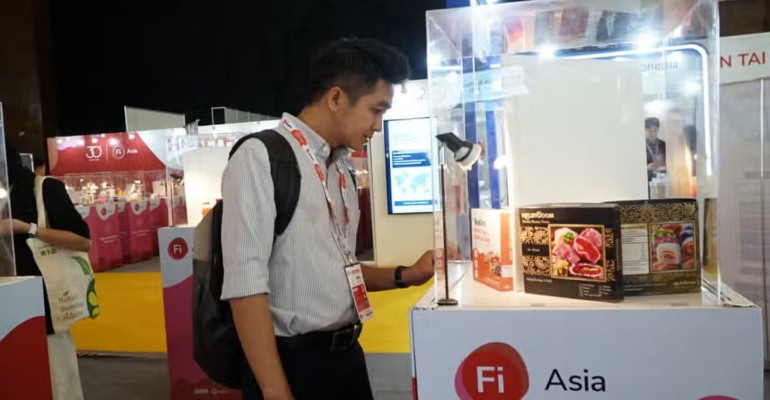
Who would have thought that a food by product such as tuna fish eyes could be transformed into a functional snack. Helbygoom, developed by an innovator from IPB University, demonstrates this potential by processing tuna fish eyes into a functional snack, which is now being showcased at Food Ingredients Asia 2026.
Helbygoom was showcased by the Institute for Agromaritime Development and Innopreneurship Acceleration (LPA2I) IPB University, alongside 19 other food and nutraceutical innovations at Food Ingredients Asia, held on 16-18 September at the Jakarta International Expo (JIEXPO) Kemayoran, Jakarta. The event provides an opportunity for the innovation to connect with industry players and broader professional networks.
IPB University Professor and Helbygoom innovator, Prof Wini Trilaksani, explained that the innovation originated from the potential DHA content of tuna fish eyes. Using the cold centrifugation method, tuna fish eyes are cleaned and crushed, then separated through centrifugation at a low temperature of 4°C at 10.000 rpm for 30 minutes.
The process produces an oil layer at the top, which is subsequently analyzed and found to be rich in omega 3 fatty acids. DHA accounts for 33,44 percent, while total omega 3 content reaches 40.10 percent of the fatty acid profile of the extracted oil.
The tuna fish eye oil was then developed into a seafood based food innovation inspired by Turkish delight, combining fiber from aquatic resources with tropical fruits, spices, and flowers. The product was also developed with reduced granulated sugar and has undergone formulation, quality testing, consumer acceptance testing, and initial market testing.
Helbygoom currently comes in seven variants, namely roselle, orange, dragon fruit, pandan, butterfly pea flower, ginger, and milk. In addition to serving as a functional snack, the product has the potential to be developed as a complementary food, souvenir or gift, hamper, or retail product.
The innovation of utilizing tuna fish eyes as a DHA rich oil source also brought Prof Wini to the Food Ingredients Asia Conference, where she presented the development of marine derived omega 3. The research focuses on extracting omega 3, particularly DHA, from tuna fish eyes as a potential source of functional food ingredients.
“The FI Asia Conference provides an excellent platform. Hopefully, the conference will further encourage researchers to continue innovating and conducting well structured research,” said Prof Wini Trilaksani.
She added that innovation development needs to be carried out through a focused approach, including the application of quality by design principles, so that research outcomes can make a tangible contribution.
Helbygoom’s presence at Food Ingredients Asia demonstrates how fisheries by products can be transformed into functional food innovations while bringing together research, product development, and opportunities for utilization within the food industry ecosystem. (*/Rz) (IAAS/CAA)