IPB University’s Faculty of Agriculture Holds National Symposium on Sustainable Rice, from Technology to Farmer Well being
Sustainable rice production cannot be achieved simply by pursuing increased yields. The environment, technology, soil health, land conservation, farmer well being, and policy must all work in tandem.
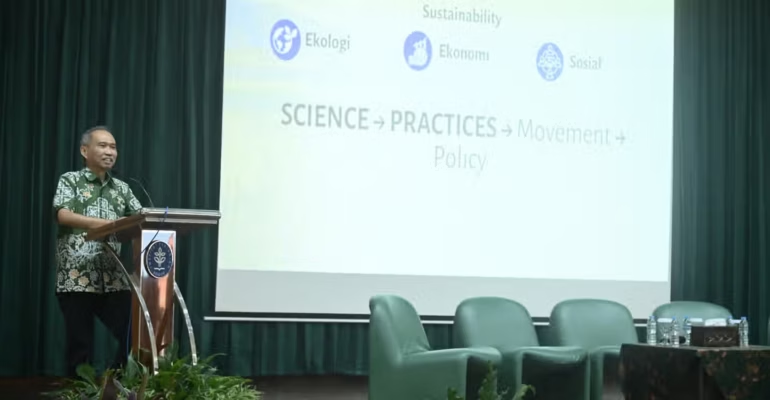
This topic was discussed at the National Symposium on Sustainable Rice, “From Field to Plate: Charting the Path for Sustainable Rice in Indonesia,” organized by the Faculty of Agriculture (Faperta) at IPB University in the Toyib Hadiwijaya Auditorium on the Dramaga Campus on Monda (9/28).
The Dean of Faperta at IPB University, Prof Suryo Wiyono, stated that agricultural sustainability should not be viewed as a conflict between production and the environment. In fact, the two are mutually supportive.
“A healthy environment supports agriculture, and good agricultural practices improve the environment,” said Prof Suryo.
According to him, sustainability must also encompass the post-production chain, from harvesting, post-harvest handling, marketing, distribution, to consumption. He cited examples such as the use of technology for irrigation efficiency, crop rotation, soil management, and the development of rice varieties that require less water.
From a policy perspective, Jarot Indarto, PhD, Director of Food and Agriculture at the Ministry of National Development Planning (Ministry of PPN/Bappenas), noted that Indonesia’s rice system has an influence extending to the Southeast Asian region.
“If we can infuse that with sustainability, it means we’ll make a significant contribution not only in Indonesia but also in Southeast Asia and globally,” he said. Therefore, he continued, sustainability must be applied to production, harvesting, post-harvest handling, pricing, and policy.
Meanwhile, Prof Widodo, a Full Professor at the Faculty of Agriculture at IPB University, emphasized the role of farmers in agricultural development. In his view, farmers must be the primary actors, not merely beneficiaries of programs.
“In any agricultural program, farmers should be the subjects, not the objects,” he asserted.
Prof Widodo also noted that economic gains do not automatically translate to farmers’ well being. Environmental aspects, soil health, and social conditions must also be taken into account.
From a land use perspective, Prof Baba Barus, a Professor in the Department of Soil Science and Land Resources at IPB University, argued that sustainable rice producing areas should be designated by considering productivity, economic viability, land protection, and policy support.
“We must consider whether existing programs or policies already allow us to identify or categorize a region as a sustainable rice production area,” he said.
Meanwhile, the Vice Dean of the Faculty of Agriculture at IPB University, Dr Dyah Retno Panuju, emphasized that rice related issues must be viewed as a holistic system, especially amid climate change and pressures on land and water resources.
“The success of rice production can no longer be measured solely by increases in production, but also by its ability to protect the environment, improve farmers’ well being, produce high quality food, and strengthen the national food system in a sustainable manner,” he said. (Ez) (IAAS/HNF)