National Maritime Day 2026, IPB University’s LPA2I Explores National Fisheries Strategies to Address Climate Change
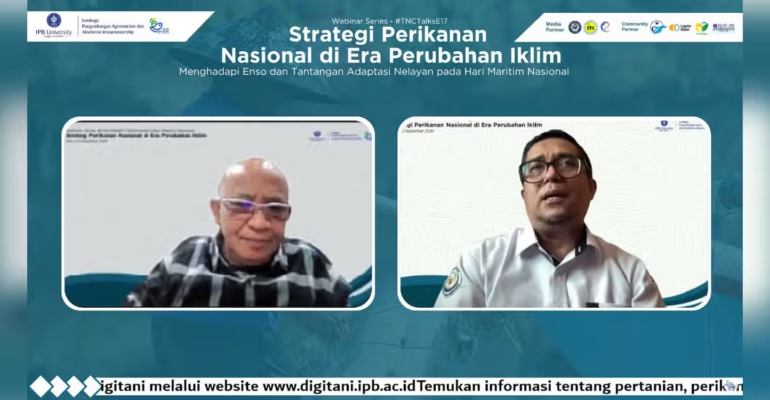
To commemorate National Maritime Day 2026, IPB University’s Institute for Agromaritime Development and Innopreneurship Acceleration (LPA2I), through its Division of Farmer and Fisherman Development, presented #TNCTalksE17.
The program was designed to discuss national fisheries strategies to address climate change, including the El Niño–Southern Oscillation (ENSO) and the adaptation challenges faced by fishermen.
The Chairman of LPA2I at IPB University, Dr Handian Purwawangsa, noted that climate change has had a tangible impact on fishermen’s activities and livelihoods. Therefore, he stated, “we need a space for knowledge exchange that brings together the perspectives of academics, the government, and the fishing community,” said Dr Handian during the opening of #TNCTalksE17 recently.
During the discussion, Prof Jonson Lumban Gaol from the Faculty of Fisheries and Marine Sciences at IPB University explained that the impacts of climate variability, such as the monsoon, ENSO, and the Indian Ocean Dipole (IOD), on fisheries production must be understood in terms of both spatial and temporal dimensions.
“Changes in oceanographic conditions can affect aquatic productivity and the distribution of fish resources. Under certain conditions, environmental changes can even influence where fish are found, so fishermen need to adjust their fishing locations, timing, and strategies,” he explained.
Therefore, he continued, the integration of satellite data, port production figures, catch data, and oceanographic information is necessary to generate insights that can help fishermen determine the best times and areas for fishing.
Another perspective was shared by the Commander of Laot Aceh, Miftachhuddin Cut Adek, SE, MSi. He highlighted the importance of community institutions and customary maritime laws in safeguarding the sustainability of coastal resources. The use of weather and sea condition information, including through collaboration with the Meteorology, Climatology, and Geophysics Agency (BMKG), is also part of Aceh fishermen’s adaptation strategies.
“Protect the sea, protect life, protect Aceh, and protect biodiversity,” he urged.
Meanwhile, the Director of Fisheries Resource Management at the Ministry of Marine Affairs and Fisheries, Dr Syahril Abd Raup, emphasized the importance of data driven and research based fisheries management. Adaptation must also include economic resilience through storage and ice facilities, market access, economic institutions, fisheries processing, and alternative employment.
The Vice Rector for Research, Innovation, and Agromaritime Development at IPB University, Prof Ernan Rustiadi, affirmed that this forum is part of efforts to strengthen the role of universities as spaces where scientific knowledge meets community needs.
Through #TNCTalksE17, IPB University’s LPA2I underscored the importance of collaboration among academics, the government, fishing communities, the business sector, and research institutions so that research findings, data, policies, technology, and local wisdom can be translated into adaptation strategies that benefit coastal communities in the face of climate change. (*/Rz) (IAAS/WSG)