Papandayan’s “Blue Fire” Goes Viral, IPB University Professor Explains the Origin of the Blue Flame
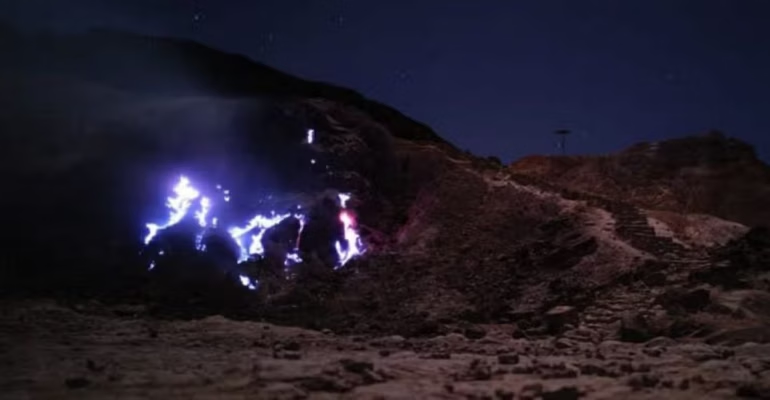
The “blue fire” phenomenon in the Mount Papandayan area, Garut Regency, has recently drawn attention after several videos taken by hikers went viral on social media.
Sonni Setiawan, SSi, MSi, a professor in the Department of Geophysics and Meteorology at IPB University, explained that the blue fire at Papandayan is essentially the combustion of sulfur gas escaping from volcanic fissures. A similar phenomenon also occurs at Ijen Crater, which has long been widely known to the public.
“The mechanism behind the blue fire is that magma beneath Papandayan releases hydrogen sulfide (H₂S) and sulfur dioxide (SO₂) at temperatures of around 200–600 degrees Celsius through fumarole or solfatara fissures,” explained Sonni.
He explained that the H₂S gas escaping through these fissures then reacts with oxygen in the air and ignites. This reaction produces sulfur dioxide, water vapor, heat, and a blue flame.
“It is the combustion of this sulfur gas that produces an electric-blue flame, with temperatures reaching around 600 degrees Celsius,” he said.
This phenomenon is easier to observe at night because the blue light from the fire is much dimmer than sunlight. At Papandayan, blue fire in active fumarole areas (holes where volcanic gas escapes into the atmosphere), including Blok Mas and the Golden Sunrise area can be seen when it is completely dark, especially between 2:00 a.m. and 5:00 a.m. WIB.
Not the First Time
Sonni added that the presence of blue fire at Papandayan is actually not a new phenomenon. It has been occurring since around 2002, after the eruption in November of that year opened a number of new fumarole channels and fissures in the Kawah Mas, Kawah Baru, and Nangklak areas.
“After the 2002 eruption, many new fissures opened up. The gas, which had previously dispersed, became more concentrated in narrow crevices with higher pressure. When mixed with air, the gas can ignite and produce blue fire,” he said.
In recent years, Papandayan’s volcanic activity has also reportedly undergone changes. According to records from the Center for Volcanology and Geological Hazard Mitigation (PVMBG), during the 2022–2026 period, there was an increase in SO₂ gas flux accompanied by a rise in shallow volcanic seismic activity. These conditions are linked to a rise in fumarole temperatures, which previously averaged around 150 degrees Celsius and have now reached 300–400 degrees Celsius.
“At those temperatures, H₂S gas can ignite spontaneously without needing a spark, making the appearance of flames more frequent,” he explained.
Do Not Approach the Blue Fire
He reminded the public not to approach the blue fire site. Volcanic gases such as SO₂ can be harmful to the respiratory system, while the ground around the fumaroles can also be unstable.
“If you’re observing at night, safety must be a priority. A regular cloth mask isn’t enough to protect against exposure to volcanic gases. Don’t approach the fumarole vents because, in addition to the toxic gases, the surrounding soil can also be unstable,” he concluded. (AS) (IAAS/KQA)