IPB University KKNT Students Introduce Sigap AWS and Gesit Tani to the PKK Women of Gempolrejo Village
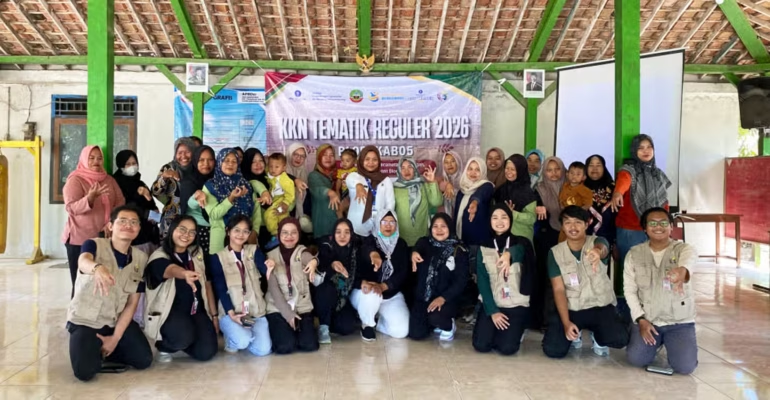
Students from IPB University organised a “Sigap AWS” event with the women of the Family Welfare Empowerment (PKK) group in Gempolrejo Village, Tunjungan Sub district, Blora Regency. This activity, which forms part of the Thematic Real Work Lecture (KKN-T) on Innovation, aims to improve the community’s understanding of weather and climate information and to encourage the use of automatic weather station (AWS) technology in daily life, family health and agricultural activities.
Blora Regency is one of the areas at a relatively high risk of drought. In 2026, the Blora Regency Regional Disaster Management Agency (BPBD) identified 149 villages and neighbourhoods across 15 sub districts as being at risk of drought during the dry season. This situation underscores the importance of the community’s understanding of weather and climate information as part of adaptation efforts.
During the event, the PKK women gained an understanding of weather, climate and the rainy season patterns in Blora Regency. The students introduced the AWS, a device for automatically monitoring weather conditions in real time, and demonstrated how to access and interpret weather information via the website map.suinaubumi.org.
According to Tiwi, an understanding of weather and climate conditions is becoming increasingly important amidst global climate change, which is making weather and seasonal patterns more difficult to predict.
“Information and understanding regarding this (weather and climate conditions) are important, given that global climate change is making the weather increasingly difficult to predict,” said Tiwi on the sidelines of the Sigap AWS event at the Gempolrejo Village Hall some time ago.
Weather information is also linked to family health, particularly during prolonged dry spells. Higher temperatures and water shortages can increase the risk of dehydration, especially among children, the elderly and vulnerable groups. Droughts can also make it difficult to meet water needs for personal and household hygiene, thereby potentially increasing the risk of skin diseases and health problems related to sanitation.
In addition to the Sigap AWS programme, the IPB University KKNT students combined their activities with Gesit Tani (the Integrated Organic Farming Education and Practice Movement), which focuses on the sorting and utilisation of household organic waste. The PKK women were introduced to the process of separating vegetable scraps, fruit peel and kitchen waste from inorganic waste, which is then processed through a decomposition process.
The Gesit Tani practice utilises plastic jerrycans as processing containers. The sorted and shredded organic waste is combined with dry materials such as dry leaves, straw, rice husks, or other organic matter. These materials are then moistened using plain water or rice washing water, and EM4 is added as an activator to aid the decomposition process.
Through this initiative, students from IPB University’s KKNT programme are encouraging PKK members to utilise household organic waste as a reusable resource. It is hoped that this effort will reduce waste generation whilst supporting the adoption of more sustainable agricultural practices in Gempolrejo Village. (*/Rz) (IAAS/HRD)