IPB University’s KKN-T Innovation Launches the Gerakan Resap Bumi Initiative Through the Construction of Biopore Infiltration Pits in Sindangsari Village, Subang
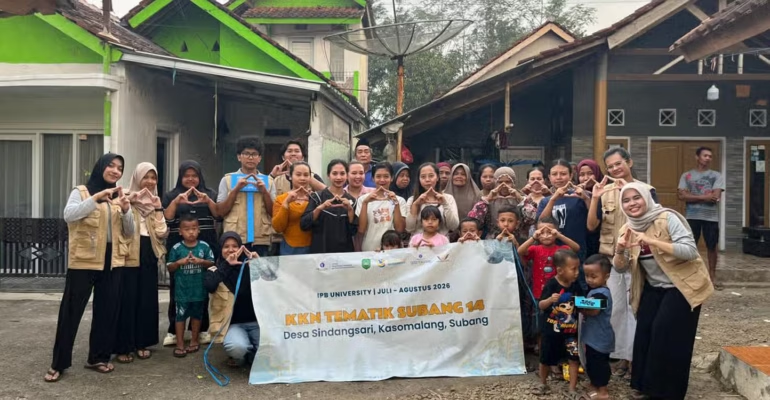
The Innovation Real-Thematic Work Lecture (KKN-T Innovation) team from IPB University in Subang Regency, West Java, carried out a community service activity as part of the Gerakan Resap Bumi programme, involving the construction of biopore infiltration pits (LRB) in Sindangsari Village, Kasomalang Sub district.
This activity involved the creation of 12 biopore sites spread across RW 1, RW 6 and RW 7 in Sindangsari Village as an effort to improve water infiltration whilst encouraging the utilisation of household organic waste.
Mas Alvy Dwi Sayaza, one of the team members, explained that the activity began with a community awareness session on the importance of waste sorting and an introduction to biopores as a simple solution that can be implemented in domestic settings.
“Biopore infiltration holes are created with a diameter of 10 cm and a depth of up to 1 metre using a biopore drill. These holes serve as a medium for water infiltration as well as a site for processing organic waste. As well as improving soil permeability, biopores also aid the decomposition of organic waste into compost,” said Alvy.
Following the awareness raising session, the students, together with local residents, carried out a practical demonstration of creating biopore holes around residents’ homes. The holes were then filled with organic waste such as dry leaves, food scraps and other kitchen waste to accelerate the decomposition process.
The output from these biopores can be used as compost, which can be harvested in approximately one month. The compost can be reused by the community as natural fertiliser, and it is hoped that this will reduce dependence on chemical fertilisers whilst supporting more environmentally friendly agricultural practices.
“Through the Gerakan Resap Bumi initiative, we hope the community can continue to manage organic waste independently and make biopores a new habit in household environments,” added Alvy.
The IPB University KKN-T Innovation team hopes that the Gerakan Resap Bumi programme can provide sustainable benefits for the community of Sindangsari Village in creating a cleaner environment and encouraging the adoption of environmentally friendly waste management practices. (*/Rz) (IAAS/HRD)