SINERGI Program: IPB University Develops a Core-Satellite Model to Grow the Maggot Business
Organic waste remains a problem that requires sustainable management. Meanwhile, the demand for feed raw materials continues to rise.
In light of these two issues, IPB University, through the Center for Tropical Animal Studies (CENTRAS) and the International Research Institute for Food, Nutrition, Health, and Halal (LRI PGKH), is promoting the development of a maggot business model that focuses not only on maggot farming but also on how waste can be processed into valuable products.
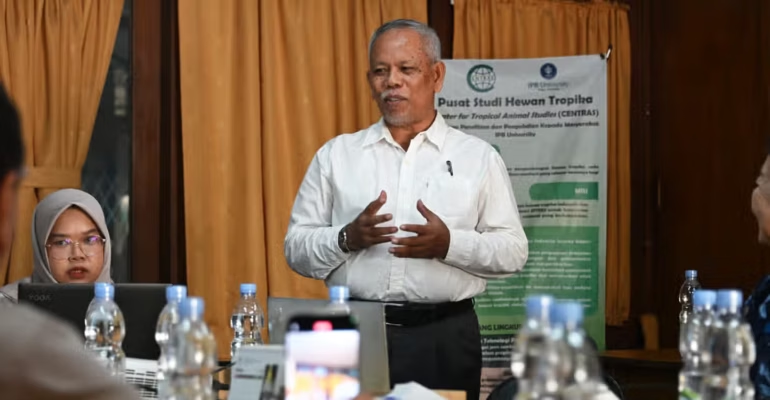
This was discussed during the event titled Maggot Business Model Outreach, Signing of the Cooperation Agreement (SPK), and Loan of Maggot Drying Machines as part of the SINERGI 2026 Program, Monday (9/14).
“Now in its second year, the SINERGI Program is focused on developing a maggot business model using a circular economy approach, specifically by processing organic waste into something useful,” said Dr Dahri Tanjung, a representative of IPB University.
According to him, IPB University plays a role in discovering innovations and delivering the results to the community. Meanwhile, commercial activities are expected to be developed through the involved partners.
Plasma–Core Model
Meanwhile, CENTRAS Director Prof Nahrowi explained the business model developed using the plasma–core concept. Partners acting as plasma do not need to carry out the entire cultivation process (from hatching eggs and raising maggots to producing eggs again).
“Plasma partners can focus on raising maggots, while other stages are handled by parties with their respective roles,” he said.
According to him, the presence of an off-taker is a crucial component of this model. With a party that absorbs the production output, partners have market certainty.
This model will involve five plasma partners with varying conditions, including partners in Jakarta, Bintaro, Tenjolaya, IPB University, and Depok. Each has different raw material potential and management conditions.
Prof Nahrowi emphasized that the relationship within the plasma–core model also requires mutual trust among the parties. The plasma units must trust the core, and vice versa.
In addition to the availability of waste, the drying process poses a significant challenge. Sun drying takes several days, while large-scale drying machines require a substantial investment. For this reason, drying machines are one of the technological supports provided through this program.
Aminudi Amin, CEO of Biomagg Sinergi Internasional, explained that developing the maggot ecosystem requires collaboration among various parties, ranging from maggot farmers and plasma partners to off-takers. According to him, this process requires not only technology but also proper management of raw materials and costs.
As part of the initiative, maggot drying machines were loaned to partners to support the production process. This facility is expected to help address one of the bottlenecks in maggot processing while supporting the implementation of the developed business model.
Through this model, IPB University is promoting the formation of a maggot ecosystem that sustainably links organic waste management, production, processing, and the market. This model is expected to serve as a pilot project that can later be expanded more widely. (Ez)(IAAS/HNY).