IPB University’s LPA2I Supports the Greening of the Tanjung Priok Port Area Through Recommendations from Fruit Crop Experts
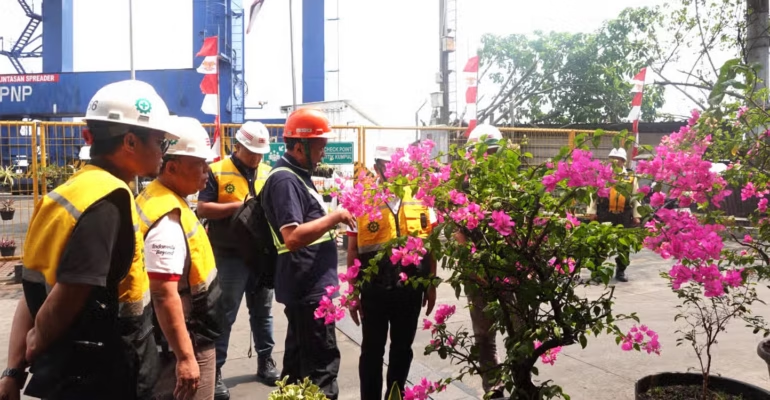
IPB University, through the Institute for Agromaritime Development and Innopreneurship Acceleration (LPA2I) in the Division of Farmer and Fisherman Development, is providing assistance to PT Prima Nur Panurjwan (PNP) in developing a greening program at the Nusantara Multipurpose Pier in the Tanjung Priok Port area, Jakarta.
This guidance involved bringing in IPB University’s Professor of Plant Breeding, Prof Sobir, to provide scientific recommendations regarding the selection of fruit plants suited to the port’s environmental characteristics.
The guidance activities began with a field survey to identify environmental conditions, land suitability, and the potential of growing media, whether in pots or directly in the ground.
Prof Sobir explained that the selection of plants in port areas is not based solely on aesthetic value but must also consider their ability to adapt to the coastal environment.
Port areas present unique challenges, including exposure to sea winds, relatively high temperatures, salinity, limited planting space, and soil conditions that differ from those in typical cultivation areas.
“The selected plants must be highly adaptable to heat, drought, wind exposure, and salinity. On the other hand, the plants also need to have controllable growth characteristics to accommodate space limitations.” he explained.
According to him, fruit trees can also be part of a greening approach that provides both ecological benefits and direct benefits to the surrounding environment. The plants’ ability to absorb carbon is one of the considerations, given that the port area is characterized by high levels of activity and mobility.
This consultation was conducted at the request of PT Prima Nur Panurjwan, a subsidiary of PT Samudera Indonesia, which is currently seeking the right types of fruit trees to cultivate on its company grounds.
Bian Adiantoro, Managing Director of PT Prima Nur Panurjwan, stated that the selection of these plants is not only related to greening efforts but also takes into account the presence of international guests visiting the company.
“We are looking for fruit trees that are suitable for planting on the company’s premises and can also be part of the environment we showcase when international guests visit. So, we want plants that are not only visually appealing but also have value and can provide tangible benefits,” said Bian.
Based on the results of surveys and field studies, sapodilla, custard apple, soursop, and the getas merah variety of guava are among the recommended plants. Sapodilla and custard apple are considered to have good tolerance to environmental conditions characterized by salinity and drought, while soursop and guava also have growth characteristics that are relatively well suited for locations with limited space. Tamarind can be an alternative because it is drought-tolerant, although its tolerance to salinity is moderate.
In terms of maintenance, LPA2I at IPB University also recommends implementing efficient techniques, such as using fertilizers with longer application intervals and utilizing carpet mulch to maintain soil moisture and suppress weed growth. This approach is expected to minimize labor requirements and maintenance costs amid the high level of activity in the port area.
The resulting plant recommendations and maintenance techniques are expected to serve as a reference for PT Prima Nur Panurjwan in implementing an adaptive, efficient, and sustainable greening program at the Nusantara Multipurpose Pier in Tanjung Priok Port. (IAAS/HNF)