Food Loss and Waste in Horticulture Reach 31,8 Percent, Prof Ketty Suketi Advocates for Precision Post-Harvest Management
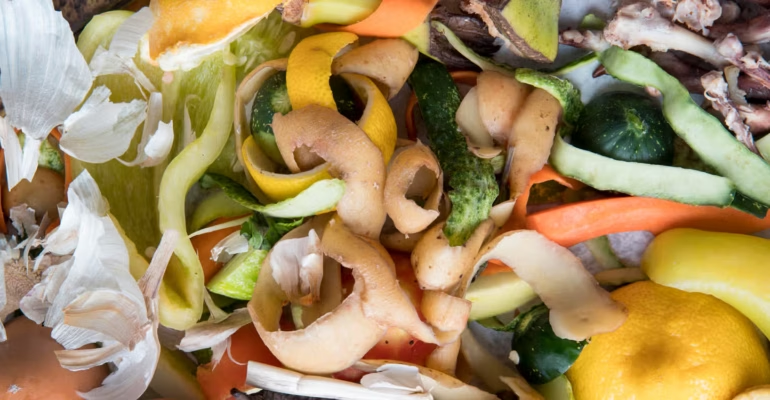
The rate of food loss and waste (FLW) for horticultural commodities in Indonesia remains relatively high. Based on Indonesian FLW data for the 2000–2019 period in the food category, losses for fruits reached 45,5 percent, while those for vegetables reached 62,8 percent of the total domestic supply.
These figures are significantly higher than those for cereal crops, which stand at 13,4 percent.
This situation is a major concern for Prof Ketty Suketi, a Full Professor at the Faculty of Agriculture, IPB University.
In her scientific lecture (8/22), Prof Ketty introduced the concept of “Precision Postharvest Management to Reduce Losses and Improve the Quality of Tropical Horticultural Crops.” This concept serves as one approach to reducing yield losses while maintaining the quality of horticultural products.
“The advantage of precision postharvest management over conventional postharvest methods lies in the precision of interventions. The technology is not applied uniformly to all commodities but is tailored to their physiological characteristics, maturity levels, timing and dosage of application, as well as environmental conditions,” said Prof Ketty.
As a tropical country, Indonesia has relatively high temperatures and humidity, which can accelerate quality deterioration and increase the risk of post harvest disease outbreaks. On the other hand, each horticultural commodity has different physiological characteristics, maturity levels, and shelf lives. For this reason, Prof Ketty emphasized the need for specific handling methods.
She explained that a number of biology based postharvest technologies have shown promising results. The application of the yeasts Aureobasidium pullulans and Candida tropicalis, for example, was able to extend the shelf life of Calina papayas by up to 13 days at room temperature , six days longer than the control group.
For mangoes stored at 15 degrees Celsius, the use of these two types of yeast extended the shelf life to 30–39 days, about 5–14 days longer than the control group.
Chemical based postharvest technologies also show potential for extending shelf life. The use of ascorbic acid and BAP on rambutan fruit can extend shelf life by about two days for export quality produce. Meanwhile, the application of chitosan to Calina papayas can increase shelf life by up to 11 days, , four days longer than the control group.
For Raja Bulu bananas, the application of potassium permanganate (KMnO₄) can delay the climacteric peak by up to eight days of storage. This can extend the shelf life while also allowing for a longer distribution window.
In addition to biological and chemical approaches, physical technologies are also part of precision postharvest management. The application of UV-C, for example, can extend product freshness for 9–12 days of storage while increasing capsaicin content.
Meanwhile, the use of blue LEDs on curly red chili peppers can extend shelf life by up to nine days compared to the control group. For rambutan, the use of white LEDs can maintain the brightness and redness of the fruit’s skin for up to six days of storage.
She added that the implementation of precision postharvest management can ultimately have an economic impact on farmers. For the domestic market, more consistent product quality can increase the chances of Indonesian horticultural products being accepted by modern markets, the processing industry, and consumers.
“As for the export market, the ability to maintain quality during storage and distribution is becoming increasingly important because products must travel longer distances and endure longer shipping times,” she said.
According to her, the direction of post harvest technology development is not about applying a single technology in the same way to all commodities, but rather about producing technologies that are increasingly practical, targeted, and tailored to the characteristics of each product.
With this approach, precision postharvest management is expected to become a key strategy for reducing food loss, maintaining the quality of tropical horticultural products, extending the distribution chain, and increasing opportunities for Indonesian products to enter higher value-added markets. (dh) (IAAS/WSG).