Why Does Puncak, Bogor, Feel Colder During the Dry Season? An IPB University Expert Reveals Several Causes
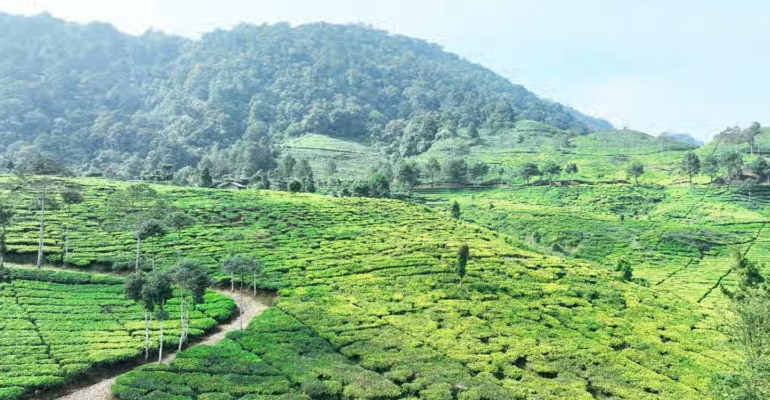
Amid the current prolonged dry season, the air temperature in the Puncak area of Bogor Regency actually feels colder in the late afternoon and evening.
According to Dr Givo Alsepan, a researcher and lecturer at IPB University’s Department of Geophysics and Meteorology, this phenomenon is very likely related to the Australian monsoon.
“The cool air felt in Puncak in the late afternoon and early evening during the dry season can indeed be influenced by the influx of air masses from Australia. These air masses are generally relatively dry and cooler as they move across Indonesia and the Indian Ocean,” he said.
However, he explained that this does not mean cold air from Australia directly enters and cools Bogor. There are several atmospheric processes occurring simultaneously.
“The Australian monsoon plays a role in shaping dry season conditions in Indonesia. During this period, air pressure in Australia is relatively higher than in Asia. This pressure difference generates an easterly to southeasterly wind pattern moving from Australia toward Indonesia,” he elaborated.
Simply put, Australia → southeasterly/easterly winds → Indonesia → Java → Bogor.
The Meteorology, Climatology, and Geophysics Agency (BMKG) forecasts that the dry season in most parts of Indonesia will last until September 2026, peaking in August. For 2026, the Australian monsoon will remain active through the end of the year at near-normal intensity.
However, Dr Givo noted that air masses from Australia are not the only factor making temperatures in Puncak, Bogor, feel cool. Relatively dry air and generally clear skies also play a role, especially in the late afternoon and evening.
“Drier air and minimal cloud cover allow the Earth’s surface to absorb more solar radiation during the day, causing it to heat up significantly. After sunset, the Earth’s surface then releases heat in the form of long wave radiation into the atmosphere and space,” he explained.
When the sky is relatively clear, with few clouds and low water vapor content, heat release occurs more effectively because there are fewer factors obstructing this radiation.
“As a result, the Earth’s surface loses heat rapidly. This process is called radiative cooling,” explained the Secretary of the Applied Climatology Study Program at IPB University.
Clear skies and lower humidity during the dry season further enhance this process, causing air temperatures to drop more quickly after sunset.
“So, the cool temperatures experienced by residents and tourists in Puncak during the dry season are the result of the interaction between the Australian monsoon wind patterns, relatively dry air masses, sky conditions, and the radiative cooling process after sunset,” he emphasized. (*/Rz) (IAAS/LAN)