
From Sumberdem Village, IPB University Drives a Community Based Coffee Revolution
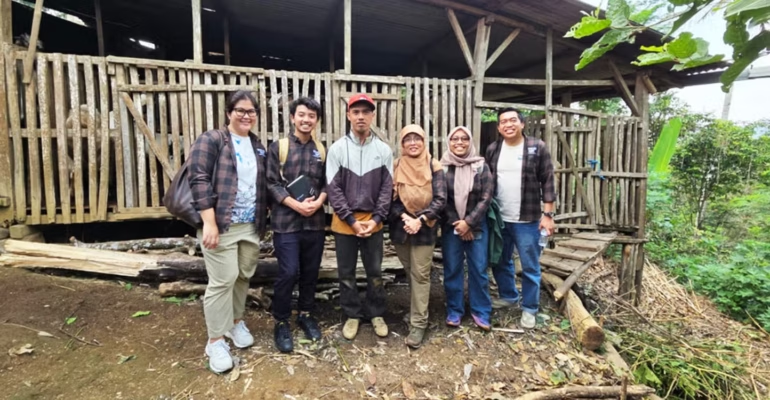
A research team from IPB University, in collaboration with Malang State University (UM), is developing Sumberdem Village in Malang Regency as a “living lab” for the Coffee Revolution. Through the Bestari Saintek Program, supported by the Ministry of Higher Education, Science, and Technology (Kemdiktisaintek), the team is working with the community to find solutions to coffee-related issues directly in the field.
Team leader, Dr Yessie Widya Sari from IPB University’s Department of Physics explained that the approach used is “proactive engagement” and co-creation. The team does not bring off-the-shelf technology packages but first maps out the problems together with farmers, business owners, village owned enterprises (BUMDes), and the village government.
“The co-creation approach ensures that the community is not merely users of technology but actively participates in creating solutions. In a living lab, we don’t want to just show up with technology and ask the community to use it. We start with the problems they face, then work together to determine what can be done,” said Dr Yessie.
The selection of Sumberdem as a living lab was supported by the well established coffee ecosystem in the community, ranging from cultivation and processing to marketing. The presence of farmers, business owners, the Village Owned Enterprise (BUMDes), Kampoeng Kopi Sumberdem, and the village government serves as a vital foundation for linking innovation with local economic activities.
This co-creation process was further refined through the Coffee Revolution Collaboration Meeting (8/8). This event served as a forum to revisit discussions on the issues, needs, readiness, and potential solutions to be developed. The event involved IPB University, UM, the Sumberdem Village Government, coffee farmers and industry stakeholders, BUMDes Sumberdem, Kampoeng Kopi Sumberdem, and Su-re.co.
The Three Pillars of the Coffee Revolution
Through this process, the team identified three main issues, coffee waste management, traceability systems, and institutional strengthening and coffee marketing. These three issues form the basis of the three pillars of the Sumberdem Coffee Revolution, namely Waste to Energy, Digital Traceability, and Institutional Strengthening and Human Resource (HR) Capabilities.
Under the Waste to Energy pillar, the team developed a system to utilize coffee waste through biogas technology, which produces energy and bio-slurry for agriculture. Activities also included waste management training and site surveys for biogas bag placement in collaboration with the community.
Strengthening Coffee Identity and Market Position
Under the Digital Traceability pillar, Dr R Dikky Indrawan from the IPB University School of Business developed a system to track coffee’s journey from farmers’ fields to consumers. This system is designed to enhance the transparency, identity, and competitiveness of Sumberdem coffee.
Meanwhile, Dr Rina Mardiana from the Faculty of Social and Human Ecology at IPB University focuses on institutional strengthening and human resource capacity building through leadership in product knowledge. This approach is expected to foster local champions who understand coffee from cultivation to marketing.
For farmers, strengthening this ecosystem is expected to improve their bargaining power. “The hope is that we, as coffee farmers, can set our own selling prices without being at the mercy of middlemen. Our coffee can become better known, and we can continue to communicate with the team to achieve this dream,” said Trisno, a coffee farmer from Sumberdem.

