IPB PhD Student Wins Award in China for Research on How Pollution Spreads in the Atmosphere Using the Laws of Physics
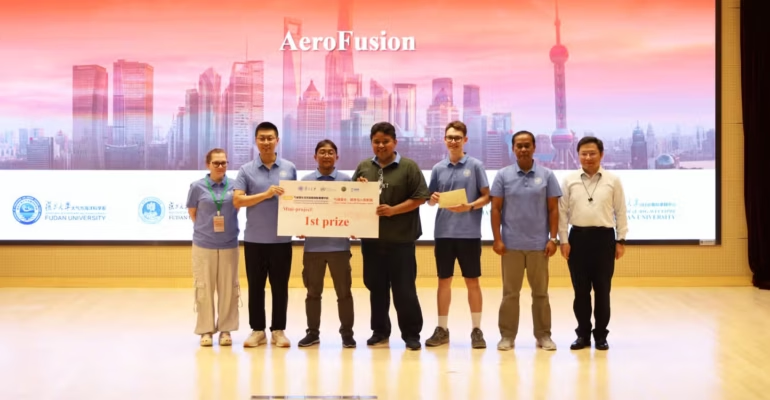
Ahmad Ripai, MSi, a doctoral student in the Department of Physics at IPB University, won First Prize at the International Summer School on Climate Change and Related Risks research competition held by Fudan University in Shanghai from July 6–23, 2026. This achievement was the result of a multidisciplinary collaboration.
At the event, Ripai and his team presented a study titled “Impact of Biomass Burning on Air Quality in China: Comparison against WHO Guidelines and National Air Quality Standards.” This research was inspired by the phenomenon of agricultural residue burning, which routinely occurs every June following the harvest season in the North China Plain (NCP).
“The scientific question we sought to answer was not merely whether biomass burning causes air pollution, but how the resulting smoke is transported by the atmosphere to affect air quality in Beijing, as well as to what extent the air pollution control policies implemented by the Chinese government have succeeded in reducing its impact,” said Ripai (8/6).
Ripai explained that this research focuses on how smoke and air pollution move and spread in the atmosphere. Using the laws of physics governing air movement, pollutants are treated as substances carried by the wind and mixed by atmospheric turbulence. Tracking these movement patterns explains why pollution does not merely accumulate at the site of the fire but can spread widely to other areas in response to seasonal changes.
“Through this framework, we mapped data on fire hotspots, fine particulate matter levels, smoke density, carbon monoxide, and soot. This data was then integrated with the NOAA HYSPLIT wind modeling system to trace the origin of the pollution reaching Beijing,” said Ripai.
The analysis revealed that when pollution levels peaked, the smoke blanketing Beijing was carried by winds from agricultural areas in the southern part of the North China Plain, where land burning was widespread. This finding connects the chain of events leading to pollution, from land burning and the release of pollutants to their transport by wind currents which ultimately worsened air quality in Beijing.
“In addition to mapping smoke movement, our research also examined the effectiveness of the Chinese government’s environmental policies. Data from the past 10 years (2013–2023) shows a fairly drastic reduction in pollution, indicating that these policies are beginning to bear fruit,” he said.
“Although air quality already meets China’s national standards during the summer, it still faces challenges in meeting the much stricter standards set by the World Health Organization (WHO),” added Ripai.
Thanks to the Research Climate on Campus
This remarkable achievement stems from the strong academic climate and robust support for fundamental research within the Department of Physics at IPB University. The tradition of discussing first principles thinking in the Theoretical Physics Division of the Department of Physics at IPB University has accustomed students to thinking critically based on the most fundamental laws of nature.
“My experience participating in the International Summer School on Climate Change and Related Risks at Fudan University further reinforced my view on the importance of theoretical research, particularly theoretical physics,” he concluded. (MHT) (IAAS/EPK)