
IPB University Research Team Develops Bioplastic Formula from Banana Stems to Extend the Shelf Life of Fresh Meat
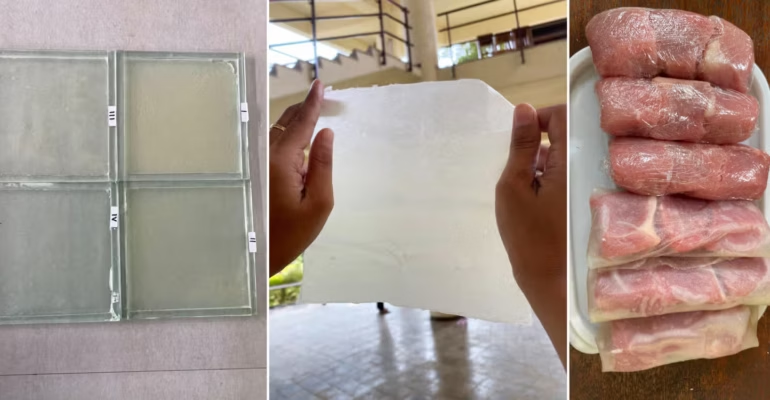
Faculty members and students at IPB University have successfully developed an antimicrobial bioplastic formula from Klutuk banana stems. This bioplastic innovation for packaging materials helps extend the shelf life of fresh meat.
This innovation has been granted a patent by the Directorate General of Intellectual Property, Ministry of Law of the Republic of Indonesia, titled Antimicrobial Bioplastic Formula Based on Klutuk Banana Stem Cellulose with the Addition of Lemongrass Essential Oil to Extend the Shelf Life of Fresh Meat.
The team consists of Della Orya Febriana, Nurul Izzah Fasya, Pharidisya Rachmi Sativa, Ario Ilham, and Erizka Febiazni, along with their advisor, Dr Nur Wulandari. This research also successfully qualified for the Student Creativity Program (PKM) and advanced to the National Scientific Week (Pimnas) as one of the finalists.
Dr Nur Wulandari explained that the antimicrobial bioplastic they developed functions similarly to conventional plastic wrap.
“Its advantage lies in its antimicrobial properties, which help preserve fresh meat by inhibiting bacterial growth. Additionally, this innovation supports sustainability and a zero waste approach because the bioplastic is easily biodegradable and can reduce the use of conventional plastic wrap,” she said.
She further explained that the bioplastic production process begins with the extraction of essential oil from lemongrass (Cymbopogon nardus (L.) Rendle) and cellulose from the stalks of the klutuk banana (Musa balbisiana Colla). Next, the bioplastic manufacturing process involves mixing the materials, heating, molding, and cooling until a sheet of bioplastic is formed that is ready for use.
One of the advantages of the bioplastic they developed is its ability to maintain the quality of fresh meat in a chiller for up to 4 days. Meanwhile, fresh meat packaged with conventional plastic wrap has a shelf life of only 2 days.
Della, one of the inventors, explained, “The main challenge of this innovation is that our bioplastic absorbs water more easily than conventional plastic wrap. However, that is precisely what allows this bioplastic to degrade effectively in the environment, making it more eco friendly.”
According to her, this innovation will be highly beneficial for supermarkets, restaurants, hotels, and food businesses that supply or sell premium fresh meat.
“With this bioplastic, we hope to protect the quality and safety of fresh meat, as well as reduce the negative environmental impact of conventional plastic packaging, thereby supporting sustainability and zero waste initiatives,” she concluded. (dh) (IAAS/WSG)

