‘Anak AC’ Content Goes Viral, IPB University Expert Reveals the Importance of Building Resilience in Generation Alpha
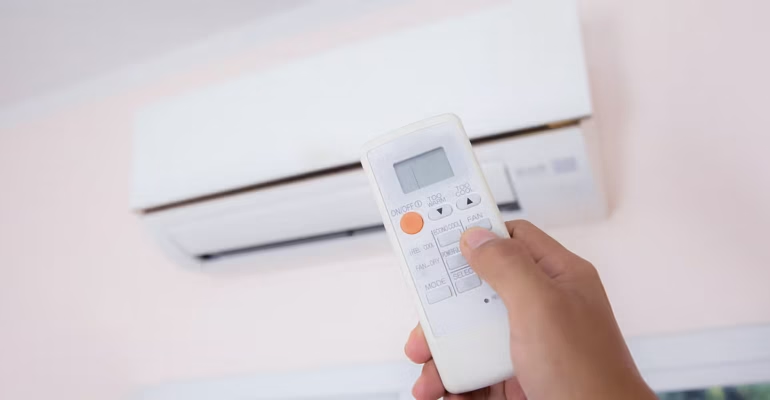
The viral ‘anak AC’ (AC Child) content, which links Generation Alpha to an inability to endure ceremonies in hot weather, serves as a reminder that technological convenience brings new challenges to parenting patterns.
Behind the various facilities that increasingly ease life, IPB University’s parenting and child development expert, Prof Dwi Hastuti, states that children still need to be trained to face discomfort in order to grow into resilient and adaptive individuals.
Gen Alpha refers to children born between 2010–2025, who are currently around 1–16 years old. This generation is growing up amid rapid developments in information technology, digitalization, and various facilities that provide comfort, including the use of air conditioning (AC).
“From a psychological perspective, this condition makes Gen Alpha children tend to become accustomed to ease, so their traits of persistence, mental resilience, and fighting spirit have the potential to be not as strong as previous generations,” said Prof Tuti.
Impact of Environment and Lifestyle
Prof Tuti added that the lifestyle surrounding children also shapes their character. The presence of social media makes children more often compare their own situation with the experiences of others or figures they follow.
“The lifestyle around these children’s environment will also affect the character of Gen Alpha, because they frequently compare the situations they face with what others and figures on social media experience,” she said.
The ease of facilities also shapes an instant-thinking habit. When feeling hot, for example, a child tends to immediately turn on the AC without trying other alternatives, such as using a hand fan, finding a cooler place, or wearing more comfortable cotton clothing.
According to Prof Tuti, this habit can make children less accustomed to seeking solutions when facing problems. A lifestyle with minimal physical activity is also becoming a trait increasingly found among gen Alpha.
She believes this condition is influenced by the family, school, and cultural environment, which increasingly prioritizes practicality. If in the past children were used to walking to school, now many are driven by private vehicles or school shuttles for reasons of comfort, safety, and efficiency.
The Important Role of Parents
Because of this, Prof Tuti emphasizes that parents have an important role in building children’s resilience. Parents need to set an example while also explaining the reasoning behind each choice, so children become accustomed to thinking, analyzing, and making decisions.
“Invite children to also experience what it’s like if they have to walk, what if they suddenly have no money, no various facilities to help them. This is so children become accustomed to risk management, so they don’t develop a “soft” mentality, easily give up, or easily lose hope,” she explained.
She also suggests inviting children to observe various social conditions around them to train empathy, engage in discussion, and learn to face various possibilities in life.
According to Prof Tuti, children who are too dependent on facilities and are always served risk experiencing difficulty adapting when facing challenges. Because of this, children need to be accustomed to doing various things independently so they are able to manage themselves, solve problems, and not easily give up.
“This is because one key to a child’s future success is being an individual who is agile, adaptable, able to solve problems, and creative,” she concluded. (dh)(IAAS/STD)