
Ten PWD IPB University Students Join Marine Research Training at UNSW Australia
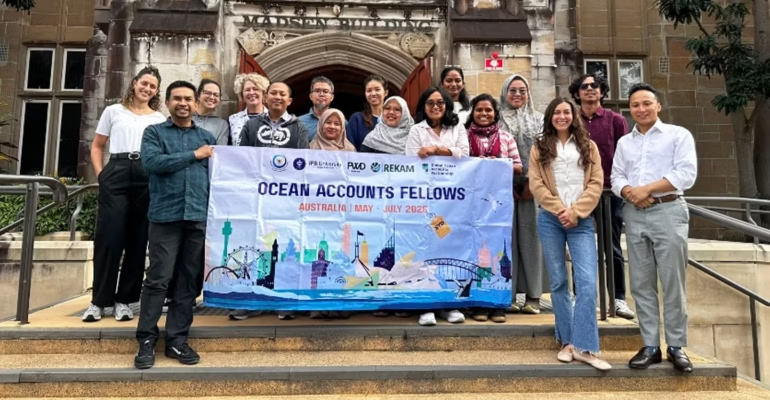
The Regional and Rural Development Planning (PWD) Study Program at IPB University’s Graduate School has carried out an academic partnership with the University of New South Wales (UNSW), Australia by sending ten students as fellows to join a short course and marine research training.
This partnership was arranged by the Rekam Nusantara Foundation together with the Ministry of Marine Affairs and Fisheries (KKP) and the Global Ocean Accounts Partnership (GOAP). It is part of an effort to build stronger research skills in ocean governance and ocean accounting.
The ten students include five master’s (S2) students and five doctoral (S3) students. The training ran for two months, from May 15 to July 12, 2026.
Prof Akhmad Fauzi, Chairman of the PWD Study Program at IPB University, praised the program. He hopes this collaboration can become a lasting model to support evidence based ocean development in Indonesia.
“This program is very good. We hope IPB University, KKP, Rekam Nusantara Foundation, UNSW, and GOAP can continue this cooperation, including continuing scholarships for the next batch,” he said.
The students took part in the full program at UNSW, guided directly by two supervisors, Dr Ben Milligan and Dr Jordan Gacutan. Both supervisors gave close guidance throughout the training helping with research ideas, sharpening methods, academic writing, and preparing presentations.
The training material was designed to strengthen research skills from start to finish. Topics included ocean accounting as a framework for measuring ocean-related data, academic writing, scientific presentation skills, and using artificial intelligence (AI) to help with writing scientific papers. Together, these topics prepared students to produce quality research and explain it clearly to different audiences, including policymakers.
Besides classroom learning, the PWD students also visited The Sydney Institute of Marine Science (SIMS). This visit gave them a firsthand look at current marine research practices and shared research facilities used by different institutions in Australia.
The students also visited Geoscience Australia in Canberra. There, they learned how remote sensing satellites are used for coastal and ocean modeling, geomatics analysis, and how earthquakes and tsunamis are identified and reported. This gave students a broader understanding of how spatial data and early warning systems work together in managing coastal and marine areas.
The training aims for two main results. First, each student will write a paper for an academic journal. Second, students will present their work to the UNSW academic community, Rekam Nusantara Foundation, KKP, and their thesis and dissertation advisors from IPB University. This presentation session lets other institutions test and give feedback on their ideas before the work is published. (*/Rz)(IAAS/ST)

