IPB University Researchers Successfully Develop Indonesia’s First Local Habanero Chili Varieties, Here Are Their Advantages
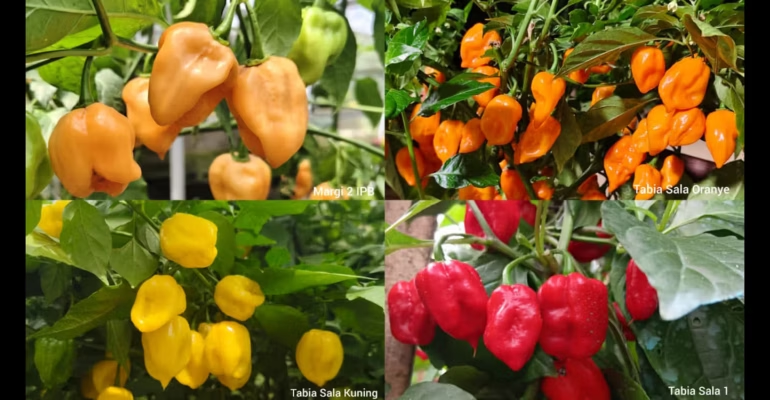
IPB University plant breeding expert Prof Muhamad Syukur has successfully developed the first four local habanero chili varieties in Indonesia, namely Tabia Sala 1 IPB, Margi 2 IPB, Tabia Sala Orange IPB, and Tabia Sala Yellow IPB. This super spicy chili variety is the first habanero variety to be officially registered with the Ministry of Agriculture of the Republic of Indonesia and to receive Plant Variety Protection (PVT).
“Basically, there were no habanero chili peppers in Indonesia before. The only one registered was Katokkon Sayang from South Sulawesi. So, the first to receive variety protection for the habanero type is our creation from IPB University,” said Prof Syukur, a full professor in the Department of Agronomy and Horticulture at IPB University and the figure behind the breeding of these local habanero chili peppers.
Super Spicy
Prof Syukur said that one of the main attractions of this innovation is its extraordinary level of spiciness, measured on the Scoville Heat Units (SHU) scale, which can be five times spicier than regular bird’s eye chili. Each variety has different color characteristics and levels of spiciness.
“Tabia Sala 1 IPB is red in color with an extreme heat level reaching 1 to 1.3 million SHU. Margi 2 IPB is peach-colored with a heat level of 350.000–500.000 SHU. Tabia Sala Orange IPB is orange in color with a heat level of 350.000–500.000 SHU. Tabia Sala Yellow IPB, which is yellow, also has a heat level of 350.000–500.000 SHU,” explained Prof Syukur.
Resilient in Tropical Climates
In addition to their high heat levels, the main advantage of these IPB University developed habanero varieties lies in their adaptability. Imported habanero peppers generally have low adaptability to tropical climates, while these IPB University varieties are specifically designed to be resilient and resistant to pests and yellow curl disease.
Seeds of these four varieties have been distributed by Benih Dramaga, making them widely available to farmers across Indonesia. Prof Syukur hopes these new chili varieties will thrive among farmers and in the industry. He believes these varieties have the potential to capture both domestic and global markets.
“Domestically, there is a huge demand for high-heat chili peppers because they allow farmers to use fewer peppers. There is a processing company in Bogor interested in developing chili powder from IPB University’s habanero variety. Additionally, there is significant potential for export to Korea as an ingredient for making heat packs used during the winter,” he concluded.
Prof Syukur revealed that his team began the breeding process for these varieties in 2020. He explained that over the course of six years of research, the team faced various challenges in the field.
“First, of course, was securing sustainable funding. Second, limited land availability and the need for greenhouses. Third, supporting human resources, ranging from breeding assistants and field assistants to field staff. Fourth, supporting facilities such as expensive equipment for analyzing heat levels,” said the IPB University plant breeding expert, who has developed more than 30 superior chili pepper varieties. (MHT) (IAAS/HLF)