Reaching 2.500 Residents in 15 Provinces, 100 IPB University Faculty Teams Return to Their Hometowns to Bring Research Innovations
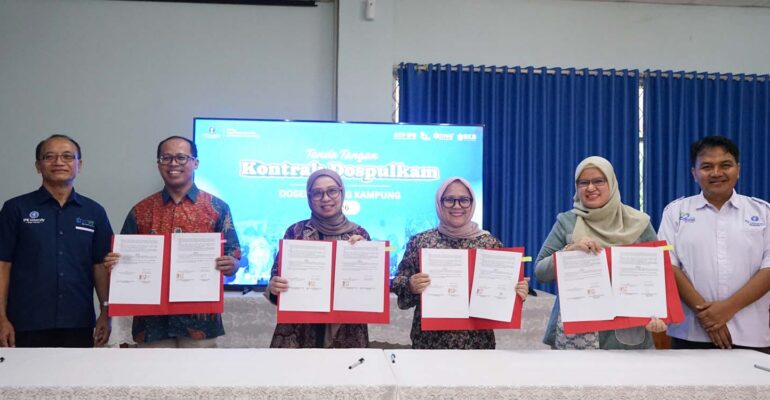
A total of 100 IPB University Faculty Return to Hometown (Dospulkam) teams are ready to carry out community service and bring innovations directly to local communities.
Dospulkam is one of IPB University’s flagship programs, initiated to encourage faculty members to implement their research findings and innovations in regions with which they share historical or sociological ties.
In this year’s implementation, the program involves approximately 400 faculty members and 200 IPB University students who will reach 2.500 community members across 97 villages/subdistricts, 55 regencies/cities in 15 provinces across Indonesia.
Prof Tri Prartono, Vice Chairman of IPB University’s Institute for Agromaritime Development and Innopreneurship Acceleration (LPA2I) in charge of Agromaritime Development and the Science Technopark, stated that the Dospulkam program continues to play a strategic role in fostering closer ties between the institution and rural communities.
“This program has been running for several years. Providing guidance to communities is certainly not an easy task, but through this process, trust is built between faculty members, IPB University, and the villages where the activities take place. That is the main focus of this program,” he said during the 2026 Dospulkam Contract Signing Ceremony on Tuesday (6/23).
According to Prof Tri, the program’s sustainability is a crucial aspect that must continue to be strengthened. He explained that not all innovations produced by universities are ready for implementation in the industrial sector. Therefore, the community serves as an ideal setting for implementation so that innovations can deliver direct benefits.
Meanwhile, Dr Supriyanto, Assistant for Agromaritime Services at LPA2I IPB University, explained that the primary goal of Dospulkam is not limited to carrying out community service activities during a single term, but rather to build a foundation for sustainable collaboration between faculty members and the community.
“The sustainability of this program is expected to emerge through the collaboration established between faculty members and the villages or regions where they carry out their activities. From these interactions, new collaborations will emerge not only through Dospulkam but also through other research and community service initiatives, such as BIMA funding or other partnership sources,” he said.
Through this approach, Dospulkam is expected to serve as a gateway to creating a multi stakeholder collaboration ecosystem involving universities, local governments, village governments, the business sector, and the community as development partners. This synergy is key to ensuring that IPB University’s innovations do not remain merely research outputs but evolve into sustainable solutions for the community. (*/Rz) (IAAS/LAN)