IPB University and Pelindo Develop Totoran Village into a Soft Shell Crab Based Maritime Center
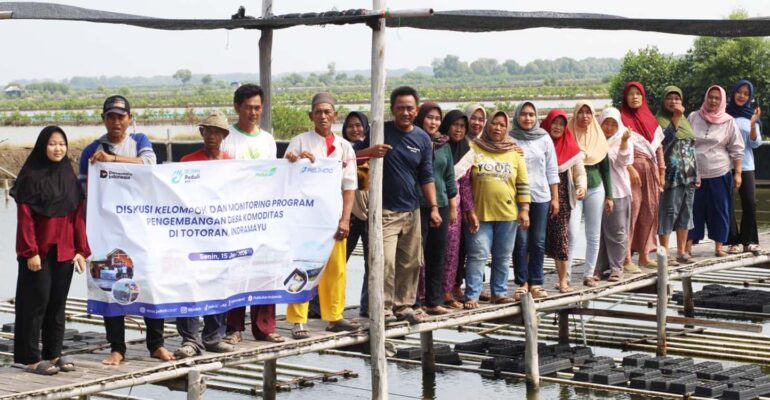
The Institute for Agromaritime Development and Innopreneurship Acceleration (LPA2I) of IPB University and PT Pelabuhan Indonesia (Pelindo) held a field visit and community empowerment dialogue in Totoran Village, Pasekan District, Indramayu Regency, West Java (6/15).
This activity served as a momentum for evaluating the maritime commodity village development program based on soft shell crab aquaculture, which has been running since July 2025 through Pelindo’s Social and Environmental Responsibility (TJSL) collaboration with technical assistance from IPB University.
Dr Irzal Effendi, an aquaculture expert from IPB University who was also involved as a program expert, explained that sustainability is the main focus of future assistance. This is so that Totoran Village can truly be established as a soft shell crab-based commodity village.
“The achievements of this first year are the foundation. Our next focus is to ensure that this development scheme runs in a gradual and sustainable manner, starting from strengthening the group’s institutional capacity, independence of seed sources, to expanding market partnerships, so that Totoran can grow into an established and independent soft shell crab commodity village,” he said.
Since its launch, the program has built a cultivation demonstration plot with a silvofishery system based on a recirculating aquaculture system (RAS) with a capacity of 5.000 crab box units operated by the community of the Pancer Berkah Bersama Farmers Group.
Dr Irzal said the cultivation results showed good performance, with the survival rate of soft shell crabs reaching 77,41 percent, surpassing the program’s initial target of 65 percent. From the assisted pond, a harvest volume of 958 kilograms of soft shell crabs was recorded, which has been marketed to exporter partners as well as local buyers, with a total overall sales value reaching approximately Rp103,6 million.
This success also attracted the interest of local investors to independently develop aquaculture units, one of whom is Carma, who has now grown to a capacity of around 15.000 crab box units, three times the capacity of the program’s assisted pond.
Beyond production achievements, the program also strengthened the governance of the Pancer Berkah Bersama Farmers Group, which now has an organizational structure, division of roles, and an actively running financial recording system. This represents a significant change compared to conditions before the program began. Its impact also extends to torchbearers, daily workers, and women who process fishery products.
The Group Head of Corporate Sustainability at PT Pelindo, Usman Saroni, stated that the program in Totoran proves that corporate support for regional leading commodities can deliver real impact on community income and quality of life.
“This program proves that multi-party collaboration, between the business world, academics, and the community, can produce real and sustainable impact for maritime economic development in the region,” he said.
The activity was also attended by Pelindo’s TJSL team, Eko Sonia and Achlakul Karim; IPB University expert, Muhammad Qustam Sahibuddin, MSi; the LPA2I IPB University facilitator team; village government representatives; the Chairman of the Pancer Berkah Bersama Farmers Group; and farmer group members.
Going forward, IPB University and Pelindo are committed to continuing to assist the sustainability of the program, including strengthening the independence of seed sources through hatchery development and expanding market partnership networks, as part of efforts to make Totoran Village a model for sustainable collaboration based maritime commodity village development. (*/Rz)(IAAS/PRP)