
Highlighting the Deaths of Sumatran Elephants, IPB Expert: Short Term Economic Interests Override Ecological Interests
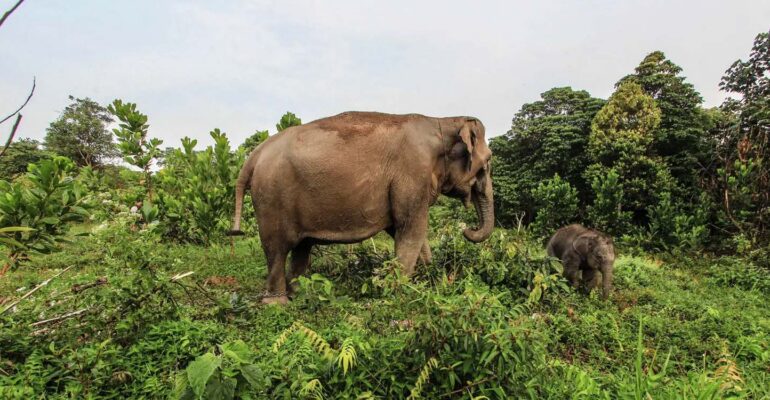
IPB University conservation expert Dr Abdul Haris Mustari views the deaths of a mother and her calf as evidence of weak law enforcement and the dominance of economic interests over ecological concerns in Indonesia.
Dr Mustari stated that the current Sumatran elephant population is estimated at only about 1.000 individuals spread across 22 landscapes in Sumatra. Meanwhile, the Sumatran tiger population is estimated to be only 500–600 individuals in the wild.
According to him, both of these animals are keystone species, as well as umbrella species and flagship species in Sumatra. By protecting the habitats of elephants and tigers, he said, other biodiversity in Sumatra will also be protected.
“The deaths of these two keystone species are primarily caused by increasingly massive deforestation, which leads to habitat loss or fragmentation, compounded by poaching,” hr said.
He explained that Indonesia actually has a fairly comprehensive legal framework for protecting wildlife, ranging from Law No 5 of 1990 on the Conservation of Biological Resources and Their Ecosystems, as amended by Law No 32 of 2024, Government Regulation No. 7 of 1999, to Ministry of Environment and Forestry Regulation No P.106 of 2018 on Protected Plant and Animal Species.
However, according to him, the main issue lies not in a lack of regulations, but rather in weak implementation on the ground. He noted that oversight remains weak, the number of conservation officers is minimal, and the effectiveness of law enforcement remains low.
“The law is more symbolic than operational. Law enforcement is also still reactive because action is usually only taken after an elephant has died or a case goes viral in the media,” he said.
Dr Mustari added that currently, many elephant and tiger habitats are being converted into oil palm plantations, mines, industrial timber plantations, and infrastructure development zones. This situation disrupts elephant migration routes and triggers conflicts with humans when elephants enter residents’ gardens.
He noted that the primary threats to Sumatran elephants include ivory poaching, poison, snares, conflicts with plantations, and land clearing. Meanwhile, Sumatran tigers are frequently victims of snares and the illegal trade in their skins and body parts.
According to him, the trade in wildlife body parts involves organized networks ranging from hunters, collectors, distribution channels, to international markets. However, law enforcement efforts to date have been seen as targeting field level perpetrators more than the key actors in the trafficking networks.
He also noted that development policies in Indonesia still treat nature as an economic object rather than a subject that must be protected. As a result, conservation often loses out to investment and industrial interests.
In addition, criminal sentences for wildlife crime offenders are considered insufficient to serve as a deterrent, as many offenders receive only light sentences or small fines.
“Conservation in Indonesia still tends to focus on species rather than ecosystems. Yet elephants and tigers cannot survive without intact forests,” he said.
Dr Mustari emphasized the need for ongoing public awareness campaigns targeting the public, law enforcement, and relevant stakeholders to ensure wildlife protection is more effective. (dh) (IAAS/HLF)

