Ministry of Education and Culture Team Commends the Administration of the 2026 UTBK-SNBT at IPB University
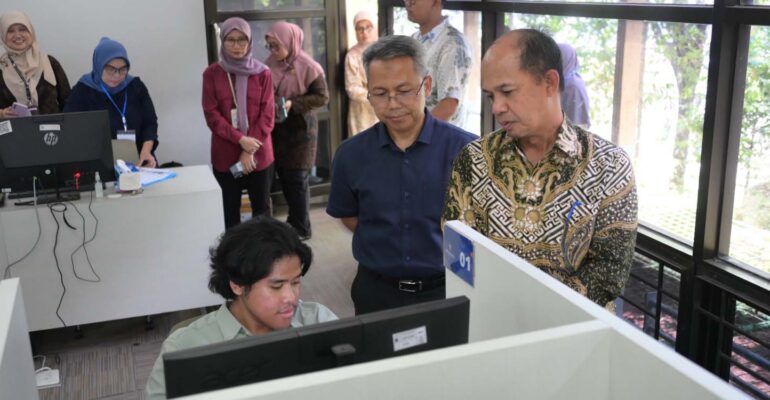
IPB University hosted a monitoring and evaluation (monev) visit regarding the implementation of the 2026 Computer Based Written Exam-National Selection Based on Tests (UTBK-SNBT) by the National Selection for New Student Admissions (SNPMB) team in collaboration with the Ministry of Basic and Secondary Education (Kemendikdasmen) at the IPB Dramaga Campus (4/24). The visit was conducted to ensure that the exam was conducted in an orderly, safe, and ethical manner.
The monitoring and evaluation activities demonstrated that IPB University’s readiness for the UTBK-SNBT met standard operating procedures (SOP), in terms of infrastructure, information technology systems, and human resources (HR).
Vice Rector for Education and Student Affairs, Prof Deni Noviana, emphasized IPB University’s readiness to provide optimal service to participants. He stated, “We are fully prepared, from infrastructure, IT, to HR, we have prepared everything well.”
He also added that IPB University aims to ensure all participants can take the exam smoothly and achieve results in line with their expectations.
Meanwhile, the Chairman of the Basic and Secondary Education Policy Agency at the Ministry of Education, Culture, Research, and Technology, Prof Toni Toharudin, stated that overall, the administration of the UTBK at IPB University proceeded in accordance with regulations. He noted that no significant violations were found and emphasized adherence to the standard operating procedures (SOP) established by the national committee.
A similar view was expressed by the Special Staff to the Minister of Education and Culture, Dr Muhammad Muchlas Rowi. He assessed that IPB University’s readiness was excellent, both in terms of examination room facilities and the dashboard based monitoring system.
Indirectly, he noted that this monitoring system enables real-time supervision of examination activities, thereby minimizing the potential for disruptions.
On the other hand, the Executive Chair of SNPMB, Prof Waras Kamdi, highlighted that there remains a potential for cheating every year during the UTBK administration, particularly the practice of proxy test takers.
He explained that the most common method is the manipulation of participant documents. Therefore, supervisors are asked to be more careful in administrative verification. He also mentioned that the change in the exam location selection system to a city based system is a strategy to limit the scope for cheating.
Furthermore, he revealed that scheduling special sessions for medical program applicants on the first day is also part of the mitigation strategy. This effort is expected to enhance the overall integrity of the selection process. (dr)(IAAS/LAN)