IPB University Inaugurates Halal Business Incubator Building
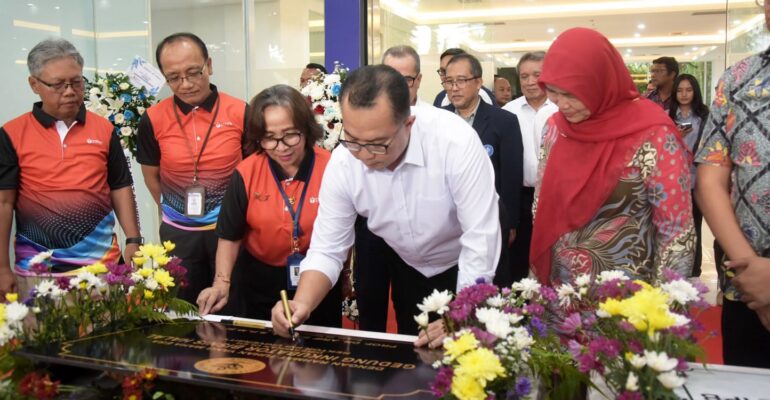
IPB University officially held the soft launch of the Halal Business Incubator Building on (11/26). The facility is located within the IPB University Science Techno Park (STP) area at the Taman Kencana Campus, Bogor.
This new facility is part of the Promoting Research and Innovation through Modern and Efficient Science and Techno Park (PRIME STeP) program supported by the Ministry of Higher Education, Science, and Technology (Kemdiktisaintek) with funding from the Asian Development Bank (ADB).
Rector of IPB University, Prof Arif Satria, described the inauguration of the building as the realization of a long-held dream to establish an integrated halal innovation center. He noted that the development of this facility was a lengthy and challenging journey.
“This building has been our dream since 2018. The process to bring it to life was not short. We crafted the idea into a proposal submitted to various stakeholders. In 2021, the proposal was approved, followed by the groundbreaking in 2023, and construction throughout 2024–2025 until it finally stands as it does today,” he explained.
He added that the facility is expected to become a stepping stone for IPB University to emerge as a leading halal reference center at the ASEAN level.
Prof Arif shared that the concept of establishing the IPB Halal Center was inspired by Chulalongkorn University in Thailand. Despite not being a Muslim-majority country, Thailand succeeded in building a halal center capable of supporting micro, small, and medium enterprises (MSMEs) and industries in producing export-oriented halal products. Many Indonesian companies even conduct halal testing in Thailand.
“Yet one of the pioneers of LPPOM MUI in the 1990s was IPB’s own professors. That made me wonder, if the pioneers were from IPB, why don’t we have an integrated halal center? This building is the answer,” he emphasized.
Four Key Functions
The Halal Business Incubator Building will serve four primary functions: halal testing, halal certification assistance, MSME incubation and mentoring, and halal research covering food, cosmetics, materials, and biosciences. The facility is also designed to serve as a training center for halal supervisors and halal assurance system training.
Prof Arif further stated that the IPB University STP has now become a national model and is being replicated across various regions through the development of Regional Research and Innovation Agencies (BRIDA). He hopes that strong innovation centers will accelerate research downstreaming and create real benefits for MSMEs.
“With strong innovation centers, MSMEs can leverage research outputs to improve productivity, enhance efficiency, and open new markets,” he said.
Meanwhile, the Chairperson of LKST IPB University, Prof Erika B Laconi, asserted that the new building will strengthen the services of the IPB STP for innovators, MSMEs, startups, industries, and the wider community.
She explained that the facility will serve as the venue for various activities aimed at strengthening the halal ecosystem, including training, workshops, seminars, focus group discussions (FGDs), business matchmaking, and industry gatherings.
“Through these programs, we hope to elevate the maturity of IPB STP while strengthening IPB’s reputation as a halal-oriented campus and a producer of leading innovations in food, agriculture, biosciences, and marine fields,” she said. (AS) (TIR/IAAS)