
IPB University and UM’s Coffee Revolution Turns Coffee and Livestock Waste into Clean Energy in Sumberdem
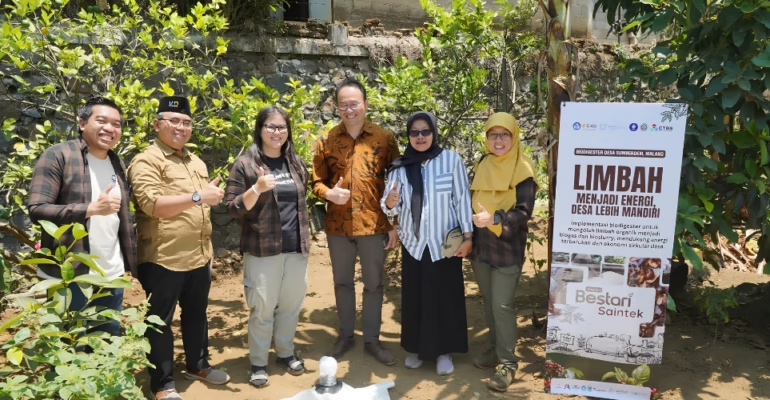
The Coffee Revolution Team from IPB University and Universitas Negeri Malang (UM) installed a biodigester and conducted training on its use in Sumberdem Village, Malang Regency (9/20). The technology utilizes coffee husks and livestock manure as feedstock for biogas production while also generating bio-slurry that can be reused for agricultural purposes.
The implementation of the biodigester is part of the Coffee Revolution’s efforts to build a more sustainable coffee ecosystem. The bag-type biodigester used in the program is relatively simple, portable, and easy to install and maintain. Through an anaerobic process, organic materials are converted into biogas as an energy source while simultaneously producing bioslurry that can potentially be returned to agricultural land as organic fertilizer.
Leader of the Coffee Revolution Team, Dr Yessie Widya Sari from the Center for Transdisciplinary and Sustainability Sciences (CTSS) IPB University, emphasized that the program is not merely about technology transfer. “Through the Coffee Revolution, we hope to build a more sustainable coffee ecosystem, with solutions that are genuinely developed, tested, and refined together with the community,” she said.
This approach positions Sumberdem Village as a living lab, where universities, communities, government institutions, and other partners jointly learn and develop solutions. The biodigester installation and training were supported by su-re.co (Sustainability & Resilience), a Bali based organization working on research and the implementation of sustainability and climate resilience solutions.
The activity is part of the Science and Technology-Based Living Ecosystem Program (Bestari Saintek), an initiative of the Ministry of Higher Education, Science, and Technology (Kemdiktisaintek) in collaboration with the Indonesia Endowment Fund for Education (LPDP). The program adopts a living lab approach to bridge university research outcomes with real-world community needs through the co-creation, testing, and adoption of innovations. During the 2025-2026 period, 122 research teams were selected to receive support through the Bestari Saintek Program.
Director of Science and Technology Dissemination and Utilization, Directorate General of Science and Technology, Kemdiktisaintek, Prof Yudi Darma, expressed his appreciation for the multi stakeholder collaboration through the Coffee Revolution. He encouraged community members and farmer groups to actively communicate challenges encountered in the field.
“Please do not hesitate to tell us when you encounter problems in the field. Share them with the IPB University and UM teams. It is precisely through these challenges that we can work together to find solutions through science and technology,” he told participants during the training.
Sumberdem Village Chief Purwati, SE, expressed her hope that the program would continue and contribute to improving community welfare. “We hope that the Coffee Revolution activities will not stop with this single initiative, but will continue and provide benefits for the people of Sumberdem, including by improving their welfare,” she said.
Going forward, lessons learned from the biodigester implementation will be further developed together with the community and integrated with digital coffee traceability, institutional and human resource capacity building, coffee residue utilization, and the development of a village circular economy. (*/Rz) (IAAS/CAA)

