Punai Gading
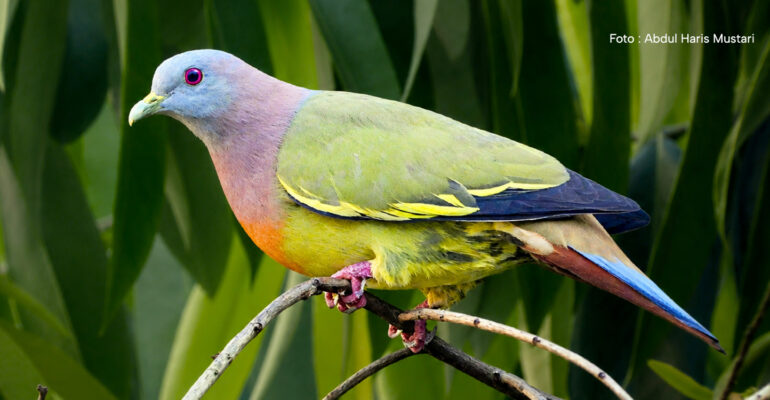
Treron vernans Linnaeus, 1771
Pink-necked Green Pigeon
Columbidae
The Pink-necked Green Pigeon (Treron vernans) feeds primarily on various types of figs (Ficus spp.), harendong fruits (Melastoma spp.), and young leaves. Therefore, this bird plays a vital role in seed dispersal within forests and the areas where it is found. Forest regeneration is made possible by the presence of the pink-necked green pigeon. This bird flies in small flocks through low-canopy forests, visiting fruiting trees to feed. Its nest is built from thin, flat twigs in shrubs near the forest floor. The eggs are white, with two eggs per clutch. Its natural habitat consists of coastal forests and secondary forests; it is rarely found in primary forests. Its global distribution includes the Malay Peninsula, the Philippines, Sumatra, Kalimantan, Sulawesi, Java, and Bali.
📍 On the IPB University campus, the pink-necked green pigeon can be found around the Faculty of Forestry and Environment, Cikabayan Forest, behind the Alhurriyah Mosque, around LSI Lake, IPB Coin Park, the Conservation Park, and the Tropical Forest Arboretum. (IAAS/HNF)
Reference :
Mustari AH. 2020. Biodiversitas di kampus IPB University: mamalia, burung, amfibi, reptil, kupu-kupu, dan tumbuhan. Bogor. IPB Press.