Hack Your Pocket: IPB University Students’ Financial Education Program for BAZNAS Cendekia School Students
“My allowance is already gone, and it’s only the middle of the week.”
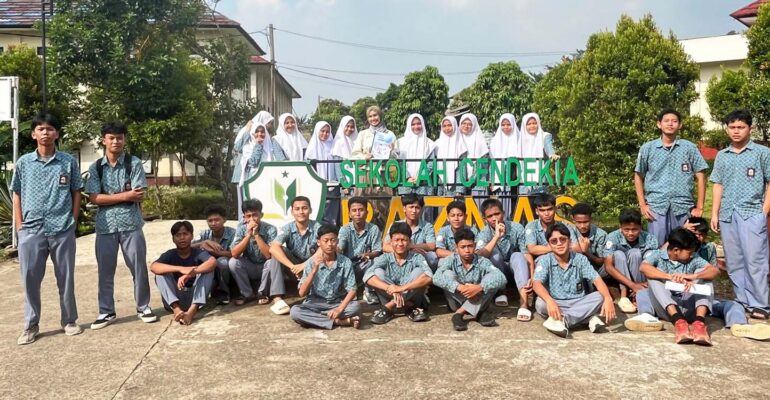
That simple statement was the most common complaint from BAZNAS Cendekia School (SCB) students when the initial sessions of the Hack Your Pocket program began. Living far from their parents, residing in a dormitory environment, and having to manage their own allowance turned out to be no easy task for 15 year olds.
Some students admitted to frequently buying snacks or small necessities without realizing it, causing their allowance to run out quickly. Others only realized they were overspending after being asked to manually record all their daily expenses.
Based on these circumstances, Tazkia Hanifatunnisa, a student in the Family and Consumer Sciences Program at the Faculty of Social and Human Ecology (FISEMA) at IPB University, launched a financial education program titled Hack Your Pocket Consumer Literacy Education at SCB, Bogor Regency.
This program is part of a community service capstone project under the guidance of Prof Megawati Simanjuntak in collaboration with SCB.
The program, which runs from April to May 2026, involves 52 10th grade high school students living in the SCB dormitory. Unlike financial education that is often associated with complex theories and numbers, Hack Your Pocket is designed to be simple and relevant to the lives of dormitory students. Through this program, students learn to manage their allowance, understand consumer rights, and build more disciplined financial habits.
According to Tazkia, a practice based approach was intentionally chosen so that students do not feel like they are participating in a boring lesson. “Boarding school students have a packed schedule. That’s why we created activities with plenty of hands on practice so they feel more connected to the material and can immediately apply it in their daily lives,” she explained.
Beyond financial management, the program also strengthens entrepreneurial skills and business service ethics through role-play simulations and the school’s Market Day activities. In these exercises, students learn to interact with customers, provide honest product information, and serve consumers politely and responsibly.
Small changes began to appear as early as the second week of the program. Students started getting used to tracking their daily expenses, being more careful when buying items, and even setting personal savings goals.
“I realized that small expenses, if done frequently, can really add up. Now I think twice before buying something,” said Kamal, another program participant.
“Usually, my money runs out quickly because I’d spend on snacks without thinking. After joining this program, I’ve gotten used to tracking my expenses and distinguishing between needs and wants,” added another student, Adit.
SCB officials also praised the program’s implementation. “This program helps students manage their allowance more discipline and be more critical of the products they consume. The kids also seem enthusiastic because the activities are practical and relevant to their daily lives,” said one of the SCB dormitory mentors.
As part of the program’s sustainability, the volunteer team also handed over learning modules, evaluation tools, and educational materials to the school. (*/Rz) (IAAS/WSG)