
IPB University Unveils the Plant Clinic Car Unit, a Mobile Laboratory for Farmers
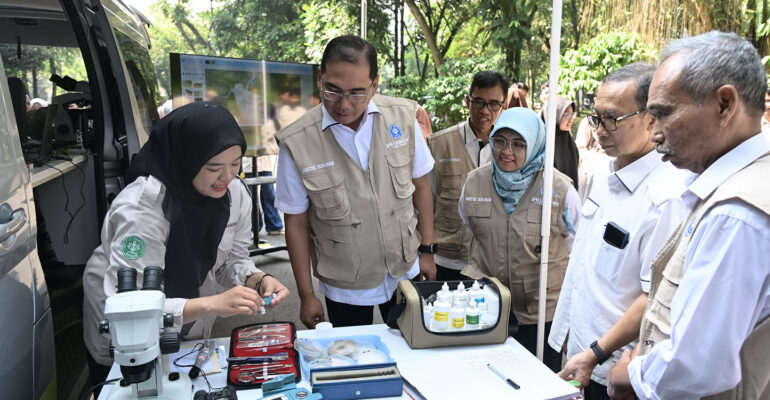
IPB University officially launched the Plant Clinic Mobile Unit at the Department of Plant Protection, Faculty of Agriculture, on 6/8. This facility was established to strengthen consultation, diagnosis, and assistance services for farmers in various regions.
The Plant Clinic Car Unit embodies IPB University’s commitment to bringing scientific knowledge, innovation, and agricultural solutions closer to the community, so that issues related to pests, plant diseases, and cultivation challenges can be addressed more quickly, accurately, and based on scientific principles.
IPB University Rector Dr Alim Setiawan Slamet emphasized that the Plant Clinic Car is a strategic step to bridge farmers’ needs for access to information and rapid resolution of agricultural problems.
“This Plant Clinic Car is exactly what is needed. It is the laboratory that must come to the field. Not all farmers have the ability or opportunity to come to the campus or laboratory. Therefore, the university must reach out to them,” he said.
According to him, the vehicle is not merely a means of transportation, but a symbol of IPB University’s commitment to delivering tangible benefits to the community. He believes that science will have a greater impact when it can be directly applied to help solve the problems faced by farmers.
“Useful science and technology is that which reaches the community, not that which remains merely stored away. The Plant Clinic Car brings solutions, knowledge, and innovation to the rice fields, gardens, and farms where farmers work,” he said.
The Dean of the Faculty of Agriculture at IPB University, Prof Suryo Wiyono, explained that the arrival of this new vehicle was highly anticipated by the Department of Plant Protection. In addition to supporting community service, this facility also plays a crucial role in the students’ learning process.
He explained that the Plant Clinic has a long history at IPB University. The program was first initiated by students from the Plant Protection Student Association (Himasita) in 1979 before being institutionalized within the Department of Plant Protection in the late 1980s.
“The Plant Clinic has two main functions: as a learning tool and as a community service. Students and faculty learn directly from real world cases in the field, while also helping farmers resolve the various issues they face,” he said.
Prof Suryo explained that, to date, the Plant Clinic has reached thousands of farmers and been involved in various efforts to address pest infestations and plant diseases, as well as providing assistance in areas affected by natural disasters.
Meanwhile, Dr Efi Toding Tondok, Chairperson of the IPB University Plant Clinic Laboratory, said that this facility is essentially a mobile laboratory that allows teams of experts to visit farmers directly.
“We’ve had a building all this time, but not all farmers want to or can come there. That’s why we go to the farmers. We discuss together to identify the root causes of problems and find the most appropriate solutions,” she explained.
The services provided include consultations on plant pests and diseases, soil fertility, crop quality, and various other cultivation issues. All these services are provided free of charge.
“When we go out into the field, it’s free. We learn together with the farmers. We don’t arrive with all the answers, but rather seek solutions together. Often, the issues we encounter also become research material for developing new innovations,” she said.
She added that the Plant Clinic Car service is open to various commodities, ranging from food crops, horticulture, plantations, to forestry. The presence of this facility is expected to accelerate the resolution of problems in the field while strengthening IPB University’s role in assisting farmers and supporting agricultural development in Indonesia. (AS) (IAAS/LAN)

