IPB University’s CEO School Equips Participants with the Knowledge to Build Socially Impactful and Sustainable Businesses
In the midst of the digital age and environmental crises, it is no longer enough to simply pursue profit. Social impact and sustainability are now key.
Through the CEO School program launched by the Institute for Agromaritime Development and Innopreneurship Acceleration at IPB University, participants are equipped not only with an entrepreneurial mindset but also with the skills to design socially impactful and sustainable businesses.
A variety of strategic materials were presented, ranging from shaping a CEO mindset to designing social impact projects. In the initial sessions, Entrepreneurship 101 and The CEO Mindset, participants were taught the importance of mental preparedness in building a business.
Fitrah Rachmat Kautsar, CEO of Citiasia Inc, emphasized the importance of having a growth mindset, an ownership mindset, a founder mindset, and an impact mindset when building a business.
Similarly, Atep Subandar, Founder and CEO of Commodity & Infrastructure Utility Company, added that a CEO’s mindset when establishing a business’s vision, mission, and strategy also influences the business’s sustainability.
“A business leader must be able to make decisions by weighing various consequences and adopt a 360 degree mindset when facing business challenges,” he added.
The speaker also shared his experience in building a coffee business and emphasized the importance of maintaining relationships, product quality, supply continuity, and communication with stakeholders so that the business can compete in the international market.
Not only that, the presentation of strategies to maintain product existence through digital marketing and the use of social media also became an interactive discussion during the session.
In the next session, the focus shifted to how businesses can create tangible impact. During the “Designing Social Impact Projects” session, Yunan Isnainye from BSI Maslahat explained that social projects must be designed based on community needs through observation, interviews, and analysis of socio-economic data.
Participants were also introduced to various tools such as Problem Tree Analysis, Village SWOT, Stakeholder Mapping, and Value Chain Mapping to systematically map out problems and solutions. Furthermore, the importance of a clear value proposition, measurable impact indicators, and the application of ESG (Environmental, Social, Governance) principles was emphasized.
During the session titled “Creating Impact from Land and Sea,” Dr Beginer Subhan explained that the agromaritime sector holds great potential for the development of sociopreneurship. According to him, business value is not only found in production, but also in processing, distribution, and marketing.
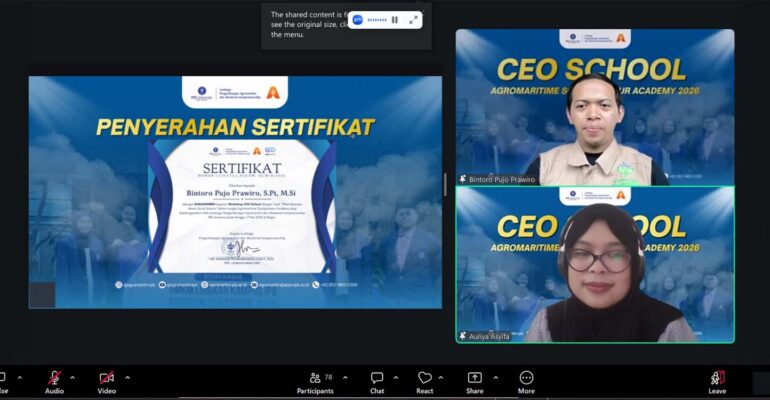
The final session highlighted the integration of business and social mission. Bintoro Pujo Prawiro, Founder of Dipala Indonesia, emphasized the “Business First” concept as the primary foundation.
A business must have a strong core before expanding its social impact.
The Triple Bottom Line concept (profit, people, and planet) serves as the foundation for building a sustainable business. One example of its implementation discussed was the development of Lawu Arabica Coffee based on agroforestry, which not only increases farmers’ income but also preserves the environment.
Through this CEO School series, participants understand that business success is determined not only by ideas but also by execution, team management, adaptation to change, and the ability to integrate economic value with social impact in a sustainable manner. (*/Rz) (IAAS/EXC).