National Education Day, International Students at IPB University Share Stories and Educational Experiences from Their Home Countries
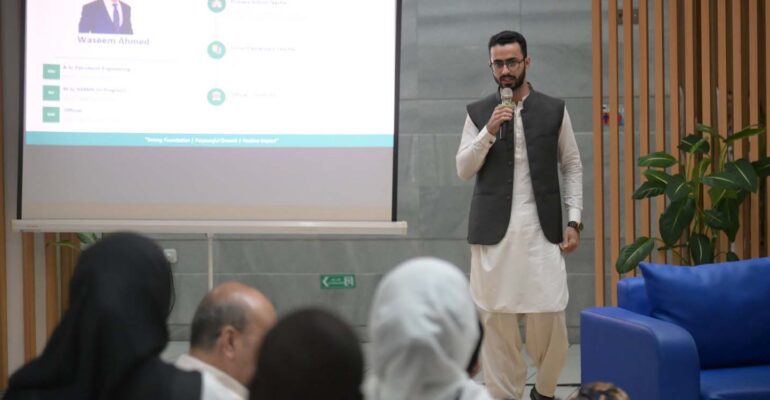
There was an interesting aspect to the 2026 National Education Day (Hardiknas) celebration at IPB University. After the ceremony, international students gathered to share stories about the education systems in their respective countries.
Through the International Student Forum (ISF) organized by the Directorate of International Education, students from various countries exchanged experiences while broadening their perspectives on the diversity of education worldwide.
The Director of International Education at IPB University, Dr Raden Dikky Indrawan, stated that this forum serves not only as a space for sharing but also as a means of building a shared future through education.
“This event is a significant milestone for Indonesian education. Through this forum, we learn that cultural differences are not barriers, but rather strengths that enable us to grow together toward a better future,” said Dr Dikky during the opening ceremony at the Collaborative Lounge, IPB Dramaga Campus (5/2).
Furthermore, he explained that studying abroad provides a broad perspective on cultural diversity and educational systems. This, he noted, serves as a key foundation for addressing global challenges.
He also added that IPB University is strengthening its internationalization strategy by increasing the number of international students to at least 6 percent or approximately 2.500 students over the next few years.
To support this goal, IPB University offers a number of international scholarships and collaborative programs with global industry partners. These programs are designed to provide broader access to education for international students while enhancing academic quality through international collaboration.
Samuel Kamau Maina, a student from Kenya, explained that his country’s education system is competency-based, with an emphasis on practical skills, creativity, and digital literacy. He noted that education in Kenya also integrates environmental values and sustainability into the curriculum.
Samuel also noted that the agricultural sector serves as the backbone of Kenya’s economy, contributing nearly 40 percent to the gross domestic product (GDP). This highlights similarities with Indonesia in terms of agricultural potential, thereby opening opportunities for academic and research collaboration between the two nations.
Meanwhile, Waseem Ahmed, a student from Pakistan, explained that the education system in his country consists of three main streams: public education, private education, and religious based education (madrasah).
He explained that these three systems operate in parallel and complement one another in developing competent human resources. He also emphasized that education in Pakistan is a fundamental right guaranteed by the state, particularly for children aged 5 to 16.
In his presentation, Waseem noted that the diversity of the education system is a strength in itself when it comes to addressing the needs of a dynamic society.
A similar view was expressed by Mila Rose, a student from France, who highlighted the differences between the education systems in France and Indonesia. She noted that each country has a unique approach, ranging from theory based systems to clinical practice, as well as differing interactions between students and faculty.
In her view, cross national learning experiences demonstrate that education is not limited by geographical boundaries. (dr) (IAAS/KQA)