
Rector Reports the Performance Achievement of First Semester at the MWA Open Plenary Session
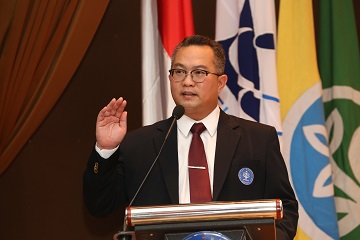
Rector of Bogor Agricultural University (IPB), Dr. Arif Satria, delivered the Performance Report of the First Semester in 2018 at the Open Plenary Session of the Board of Trustees (MWA), Friday (28/9), at the Andi Hakim Nasoetion Auditorium, IPB Dramaga Campus, Bogor.
IPB Rector reported the Rector Performance of IPB in the First Semester of 2018 which included several aspects, namely education, research, community service, development of innovation and business, organization, human resources, finance, facilities and infrastructure, information and communication technology, as well as student affairs and alumni. The Rector explained that the total performance achievement was based on the perspective of the Performance Management Information System in 2018 with a total achievement of 84.12 percent consisting of the financial sector reaching 87.07 percent, 82.39 percent for stakeholders, 74.53 percent for academic excellence and research, 95.39 percent for internal business processes, and 89.50 percent for capacity building.
In his report, the Rector of IPB stated that there were about 43 percent of IPB students' parents who had income under 3 million and only eight percent of students paid full tuition according to the applicable Single Tuition Fee (UKT). This value was actually less than the cost of education for IPB students every semester. "I hope that IPB will become a campus that can alleviate poverty in Indonesia. Education can change the family's economy in Indonesia. I encourage many intelligent children from weak economic circles to go to higher education so they can change the fate of their families. When they graduate, they may change their family's economy with the knowledge they gain from the university," said the Rector of IPB.
As stated by the Rector of IPB, many other universities limit the Bidikmisi quota concerning the costs. "For IPB, the number of Bidikmisi students is a blessing. We hope for prayers from them. I am sure that their prayers will make IPB stronger. It is usual if the smart and the rich ones enter IPB. IPB will be more powerful if someone who is unable to enter IPB because of economic aspect can graduate from IPB and become great people," said the Rector of IPB.
The Open Plenary Session of MWA of IPB was opened by the Chairman of the MWA, Prof. M.A. Chozin, who directly led the event. Prof. Chozin conveyed the MWA's request for the Rector to formulate an IPB Strategic Plan of 2019-2023 to examine in depth and comprehensively the existing strategic environment, both nationally and globally.
According to Prof. Chozin, there are several strategic environmental issues that currently and in the future need to be observed. "There are four strategic issues that need to be addressed wisely. First, an era of disruption filled with uncertainty, turbulence and complexity. The era of disruption triggered by the advancement of digital technology requires IPB to be more sensitive to the signals of change, both ways of thinking, work culture, business processes, and organizations. Second, the scarcity of natural resources has become an important issue in the world. Universities need to respond to the problems of scarcity of natural resources and environmental damage that have a major impact on the economic order and create poverty and low quality of life in various parts of the world. Third, the nationality issue that has recently emerged on the surface requires the role of Higher Education (PT) that appears as the glue of the national spirit. Fourth, regeneration of farmers is hampered due to the declining interest of young people to contribute to the agriculture. Those are why IPB is called," said Prof. Chozin.
The Performance Report of IPB Rector for the First Semester in 2018 was presented in front of the MWA and invited guests, namely representatives of the Ministry of Research, Technology and Higher Education of the Republic of Indonesia (Kemenristekdikti RI), representatives of the Governor of West Java, Rectors of state universities and private universities in Bogor and West Java, representatives of the Regent and Mayor of Bogor, as well as IPB's officials, students and partners. (dh/ZSP/ris)

