Response to Drought, IPB Holds Cooperation Seminar with Wageningen University of The Netherlands
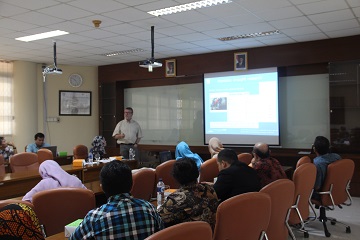
Three working units of the Bogor Agricultural Institute (IPB) namely the Directorate of International Program, Department of Geophysics and Meteorology and Center for Transdisciplinary & Sustainability Sciences (CTSS) held The 11th IPB Talks on Complexity and Sustainability Sciences with the theme "Land Use Change, Water, And Drought ". Located at the Graduate School Building of IPB Dramaga Campus, Bogor (10/7). This seminar was attended by approximately 25 audiences with diverse scientific backgrounds.
The presenters are Henny A.J Van Lanen who is an Associate Professor of Wageningen University and Research (WUR) and Dr. Suria Darma Tarigan who is Associate Professor of Soil and Land Resources Department, Faculty of Agriculture IPB and also representatives from IPB CTSS and moderator Dr. Tania June who is Associate Professor of the Department of Geophysics and Meteorology Faculty of Mathematics and Natural Sciences IPB.
Aiming to improve the awareness of the impact caused by drought, Dr. Henny describes how serious the drought threats the earth.
"Drought is multi-hazard disaster. The water crisis is a serious threat that ranks second to ten global risks in terms of the most likely disasters and ranks first in a list of ten global risks related to impacts, "said Dr. Henny.
Dr. Henny added that drought problems are now being taken seriously by governments in many countries beyond the issue of nuclear weapons, global diseases, flooding cycles and water pollution. Cape Town, one of the cities in South Africa, suffered drought disaster as evidenced by the drastic reduction of water supply each year. The latest data of January 2018 states that Cape Town has only about 300 Giga Liters of water.
"The drought projected in 2100 by Wander et al (ESD, 2015) shows the worsening impact that will result if there was no action of adaptation and mitigation before the entire continent would experience drought. Not only are the ecological impacts of the environment, but also human activity will be greatly disrupted by this catastrophe, "said Dr. Henny.
The same thing was said by Dr. Suria, which stated that as a tropical country with vast forest area and biodiversity, does not always make Indonesia safe from drought threats. The phenomenon of water crisis in some regions in Indonesia, especially Java Island, is increasing annually. This is indicated by the increasing use of water that is not in line with the existing inventory.
"Some areas are categorized as vulnerable to the crisis, they are Bengawan Solo river area, Brantas River area, Karimun island and several other areas. Java's drought-prone levels are already at the red line stage or its water use index has exceeded 50 percent. This is certainly very worrying, "said Dr. Suria.
He added that not only had a negative impact on the depletion of water supplies for humans, the drought also resulted in the drying of agricultural land and water reservoirs for hydroelectric power plants in the regions. This has indirectly affected the loss of food and electricity supplies for the wider community.
Dr. Suria hopes that future water resources management should be more emphasized on transdisciplinary approaches such as local knowledge, knowledge relating science to society and others. This discussion is increasingly rich with the exposure of other resource persons. (DMR).